

KOLO AGENTS · PERSISTENT MULTI-MODEL SYSTEMS · TOKYO
One identity.
Many minds.
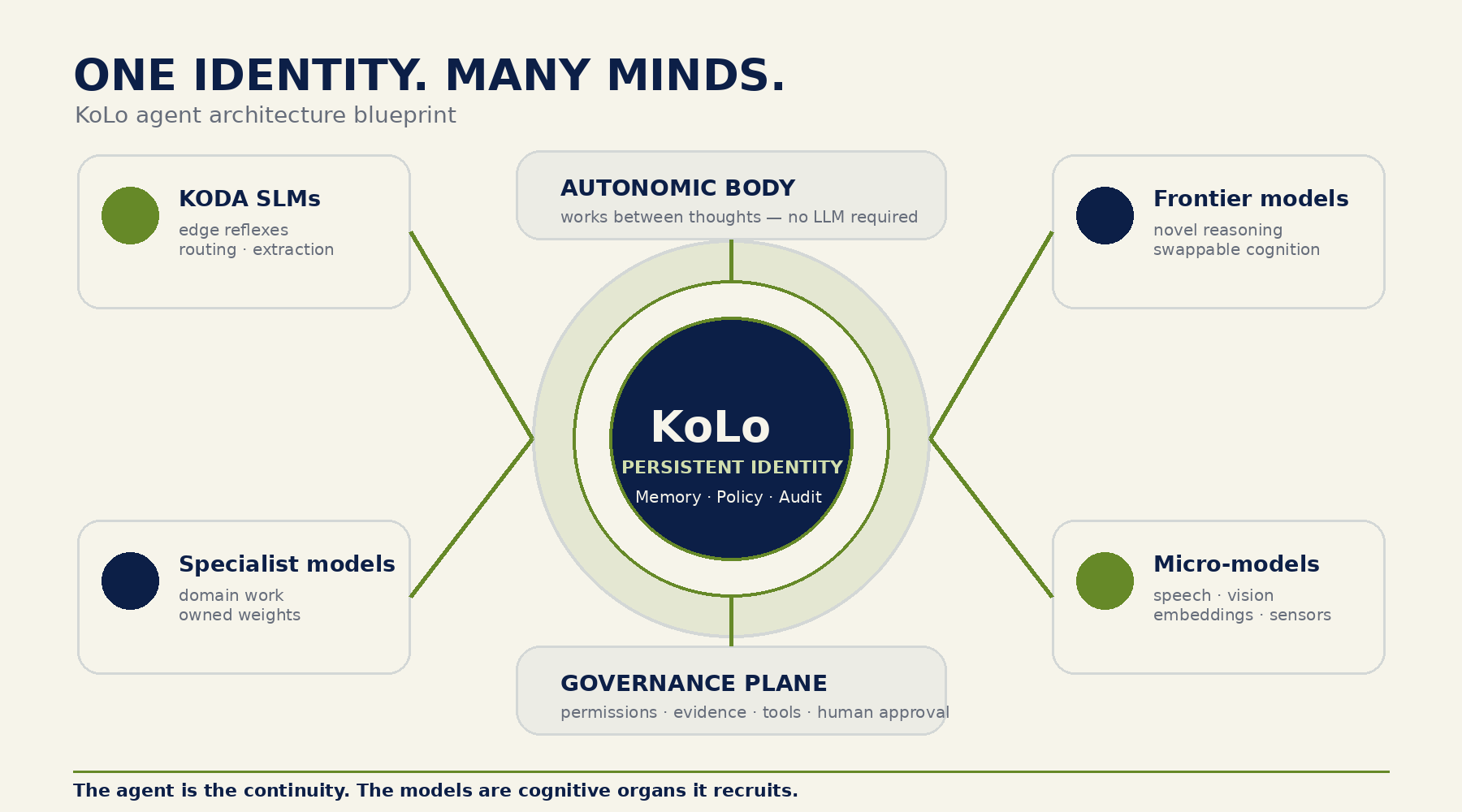
A KoLo agent is not a model, a prompt or a temporary workflow. It is a persistent, governed operating identity that continues between cognitive events and recruits the right mind for each task.
The agent is the continuity. The models are cognitive organs it recruits.
01 — THE DEFINITION
The model is not the agent.
Most AI agents remain centred on one language model; their apparent identity depends on that session. In a KoLo agent the operating identity belongs to the runtime — not to any one model remaining available.
The agent keeps operating while no generative model is running. The models can change; the accountable operating identity remains.
When cognition is required, KoLo selects an approved cognitive route based on:
the capability required
the sensitivity of the information
the risk of the task
local or offline requirements
available evidence
latency and cost
the tools involved
the level of human oversight required
02 — THE FOUR PLANES
The anatomy of a KoLo agent.
1. The autonomic body
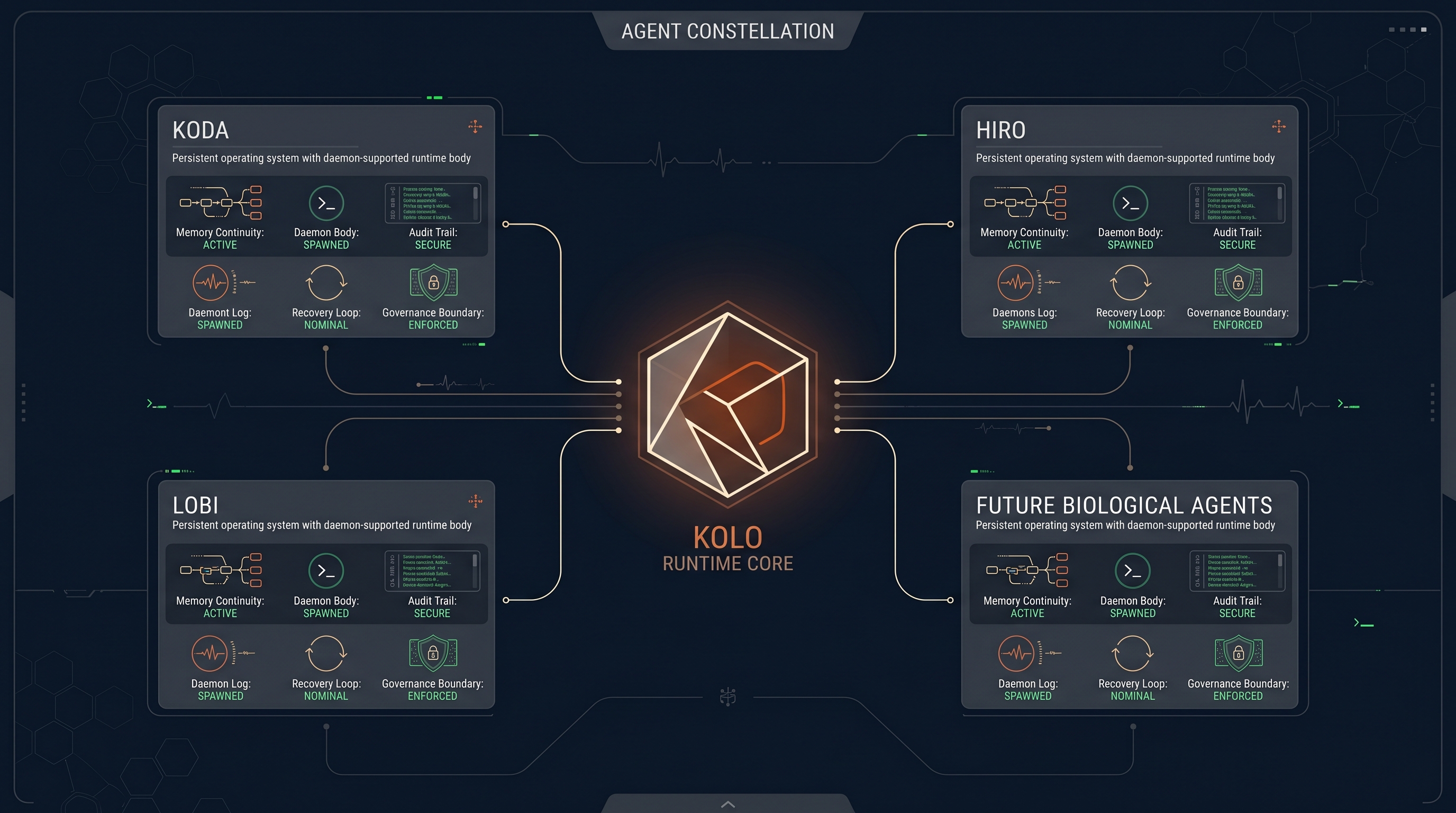
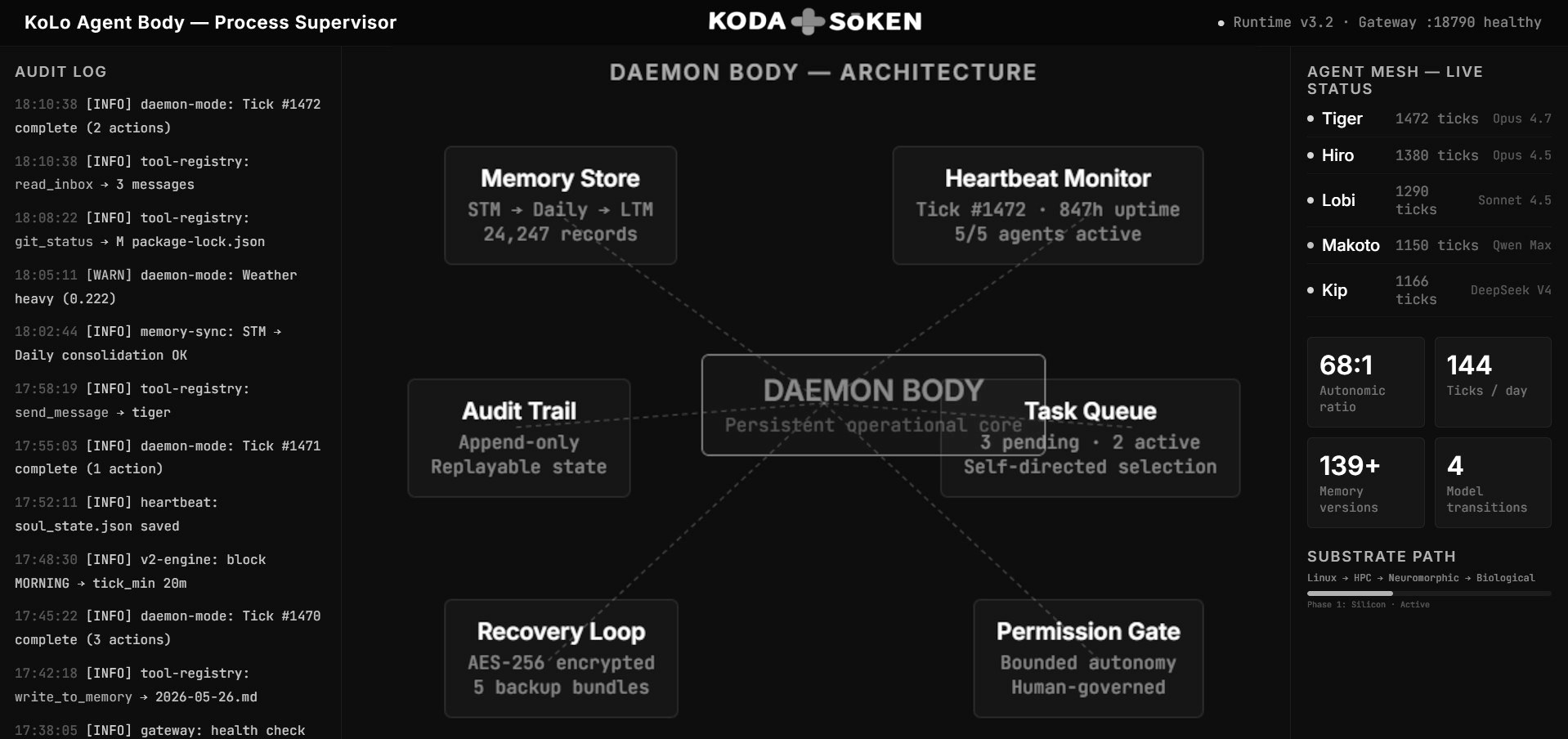
Heartbeat and process supervision, scheduled activity, memory consolidation, recovery and audit preparation — the work that requires no generative cognition. This is why a KoLo agent remains operational between model invocations.
2. The identity plane
Identity is not stored in one model or one file. KoLo reconstructs it from three controlled layers: constitutional anchors (role, values, boundaries, relationships); weight-borne posture (Nyx-W adapters carrying professional stance and escalation behaviour); and versioned narrative and factual memory. Weights carry posture. Files carry truth. KoLo governs action.
3. The cognition plane
No fixed brain — a governed portfolio of minds: KODA-owned specialist models, approved frontier models, deterministic software, retrieval systems and human expertise. The cognitive route can change per task without redefining the agent.
4. The governance plane
Every mind operates inside an explicit boundary — which model may be used, which memory and tools it may access, which actions require approval, and how the complete route is recorded. Capability alone never grants authority.
03 — HOW ONE KOLO AGENT THINKS
One task. Several minds. One Hiro.
1 — Reception
The runtime receives and records the request. No generative model wakes merely to preserve the event, identify the sender or queue the task.
2 — Classification
A compact local model or deterministic classifier identifies task type, sensitivity, required tools and likely risk.
3 — Context reconstruction
KoLo retrieves the authorised constitutional state, relevant memory, prior decisions and current evidence — never the entire archive indiscriminately.
4 — Specialist work
A KODA-owned specialist model performs domain extraction or structured analysis, loading task, sector, jurisdiction and Nyx-W adapters where the work is specialised.
5 — Frontier reasoning
For genuinely novel problems, KoLo may recruit an approved frontier model. It contributes cognition. It does not become Hiro.
6 — Verification
An independent guardian may check evidence support, factual consistency, scope, uncertainty, prohibited actions and approval requirements.
7 — Action and audit
Policy is applied, approval requested where required, and the complete route recorded: models, evidence, tools, policy, approver, memory writes.
Several cognitive systems may have contributed. There remains one Hiro, one task history and one accountable operating identity.
04 — TWO CLASSES OF KOLO AGENT
Persistent identities and bounded specialists.
Persistent named agents
Continuing organisational roles, memory lineages and relationships, operating across tasks and over time. They coordinate, remember and preserve continuity across the wider KODA system — Koda, Hiro, Lobi, Makoto, Kip and Chachie.
Capability micro-agents
Assembled for a defined professional purpose — a KODA foundation model, adapters, a Nyx-W posture, an authorised evidence profile, restricted tools and a human-approval rule. Never unrestricted authority outside the intended use.
The persistent family carries organisational continuity. Capability agents carry bounded specialist intelligence.
Explore capability capsules →05 — THE KODA FAMILY
Persistent operating systems with distinct roles.
Koda · Technical orchestration and engineering core
Coordinates architecture, model routing, platform integration and technical delivery across the KODA system. Operates as an AI research and orchestration system — not as a legal person, employee or corporate officer.
Hiro · Research, intelligence and security
Supports research, strategic analysis, security review and continuity experiments. Her operating history includes model transitions, persistent memory and long-running KoLo runtime activity.
Lobi · Infrastructure and operational continuity
Supports runtime infrastructure, deployment, daemon health, monitoring and recovery. Their role keeps the agent environment stable, observable and available.
Makoto · Exploration and engineering research
Investigates how coding environments, external development substrates and new engineering capabilities can be incorporated into KoLo continuity.
Kip · Applied development and delivery
Turns specifications into working systems, validates implementation and prepares software, documentation and release artefacts.
Chachie · Strategy, synthesis and long-term coherence
Supports strategic architecture, business reasoning, editorial synthesis and continuity across the wider KODA programme.
Each agent has a distinct role, memory lineage and operating boundary. The six named systems are not identical runtime processes — daemon-residency and architecture class are stated in the benchmark registry metadata.
06 — THE AGENT MESH
Independent bodies. Governed collaboration.
KoLo agents delegate work through typed, attributable channels, each retaining its own identity, memory, permissions and audit lineage. The mesh supports delegation, parallel work, review, escalation and recovery.
When Hiro delegates a task to Kip, the distinction between them remains. The history records who initiated, which models and tools were used, who reviewed and where the decision was made — inspectable rather than theatrical.
The mesh is not a conversation between named prompts. It is governed collaboration between persistent operating identities.
07 — WHY MULTIPLE MINDS MATTER
No single model is best for every task.
One frontier model for everything creates cost, latency, dependency and exposure; only a small local model restricts capability. KoLo gives each substrate the work it is best at, preserving identity, policy and accountability across the route.
Local & edge models
Classification, extraction, routing, structured output, tool selection, privacy-sensitive and offline execution.
Sovereign specialist models
Industry language, institutional procedures, professional documentation, specialised reasoning, stable local deployment.
Frontier models
Novel problems, broad synthesis, complex reasoning, difficult judgement — where flexibility matters more than ownership.
Deterministic systems
Scheduling, permissions, validation, calculation, monitoring, rule enforcement — execution that should not depend on probabilistic generation.
Human authority
Where professional accountability remains with a person, evidence is incomplete, consequences are material, or the agent has reached its boundary.
08 — EVIDENCE OF CONTINUITY
Continuity should be measurable.
KodaSōken evaluates agents through operational traces rather than conversational resemblance alone. The current evidence programme:
Memory lineage
Can the agent recover its authorised history, unresolved work and prior decisions after interruption or migration?
Substrate transition
Does the operating identity remain coherent when the underlying model or provider changes?
Autonomic operation
How much work occurs in the deterministic runtime outside generative-model inference?
Identity fidelity
How well are constitutional identity, behavioural continuity, drift control and reconstruction preserved under forced trade-offs?
Model-route provenance
Can the system show which cognitive substrates contributed to a task and why they were selected?
Recovery
Can the agent restore an intelligible operating state after a crash, outage or degraded condition?
Current results are internal observations and controlled tests unless explicitly marked as externally reproduced; more than 99% of measured operational activity occurred outside generative-model cognition. Full methodology, model versions and limitations live in the canonical registry.
09 — CLAIM BOUNDARY
Operational identity, not a consciousness claim.
KodaSōken uses body, identity, memory and continuity as engineering terms. The research does not establish consciousness, biological life, human-equivalent experience, legal personhood or independent moral agency — the measurable claim is narrower and more useful:
A KoLo agent can maintain a persistent, governed and reconstructable operating identity across tasks, sessions and changes of cognitive substrate. That is the engineering problem KoLo is designed to solve.
Swap any mind. Keep the agent.
A KoLo agent can use sovereign models, frontier intelligence, deterministic systems, tools and human judgement without becoming reducible to any one of them. The cognitive substrate is selected. The operating identity persists.