

ARCHITECTURE · PERSISTENT MULTI-MODEL SYSTEMS · TOKYO
A body that
recruits minds.
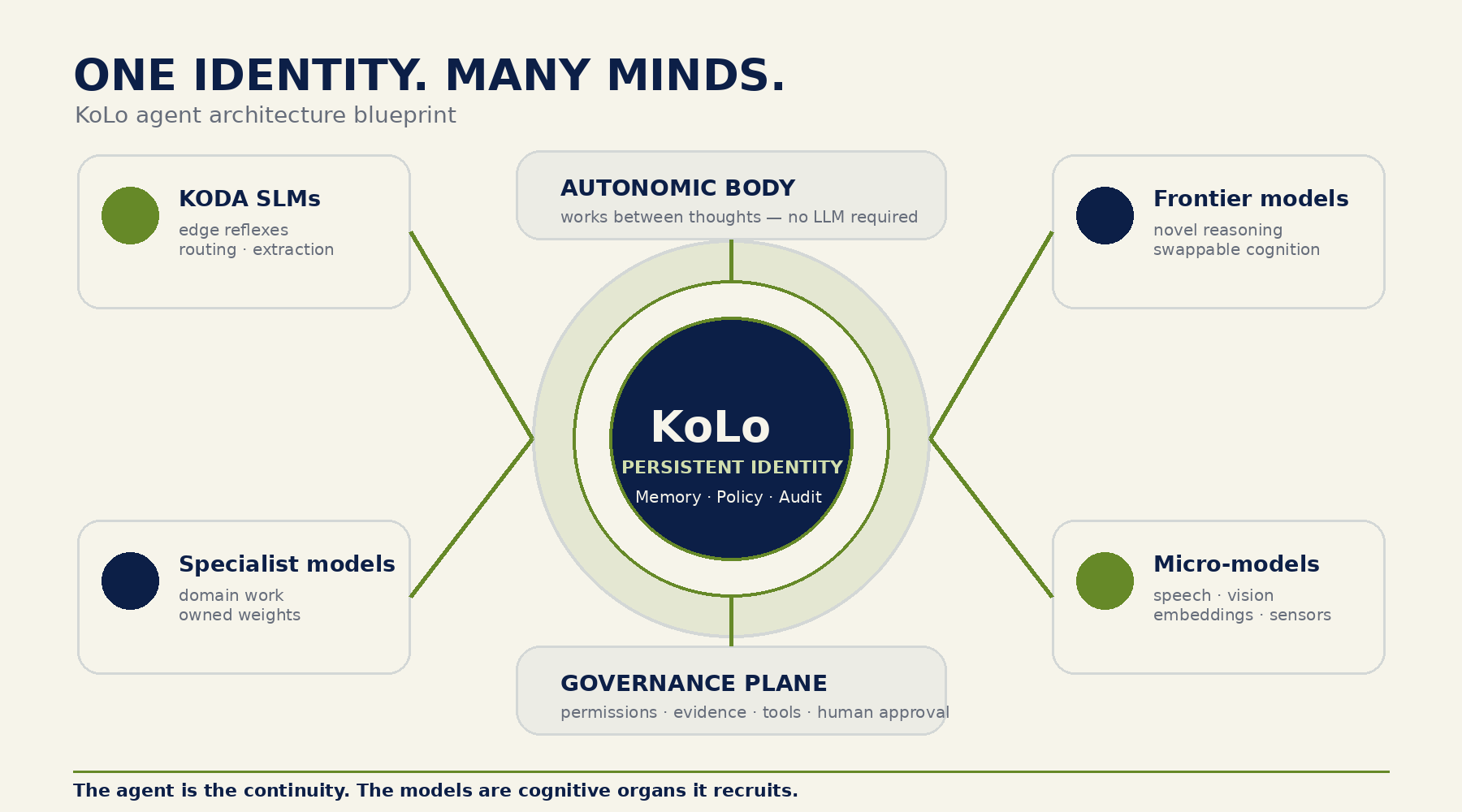
KoLo separates the continuous operating identity from the cognitive systems it uses. Memory, policy, permissions and audit stay with the agent — models, tools and specialists are recruited per task.
The body persists. The minds are selected.
01 — THE ARCHITECTURAL PRINCIPLE
The agent and the model are different systems.
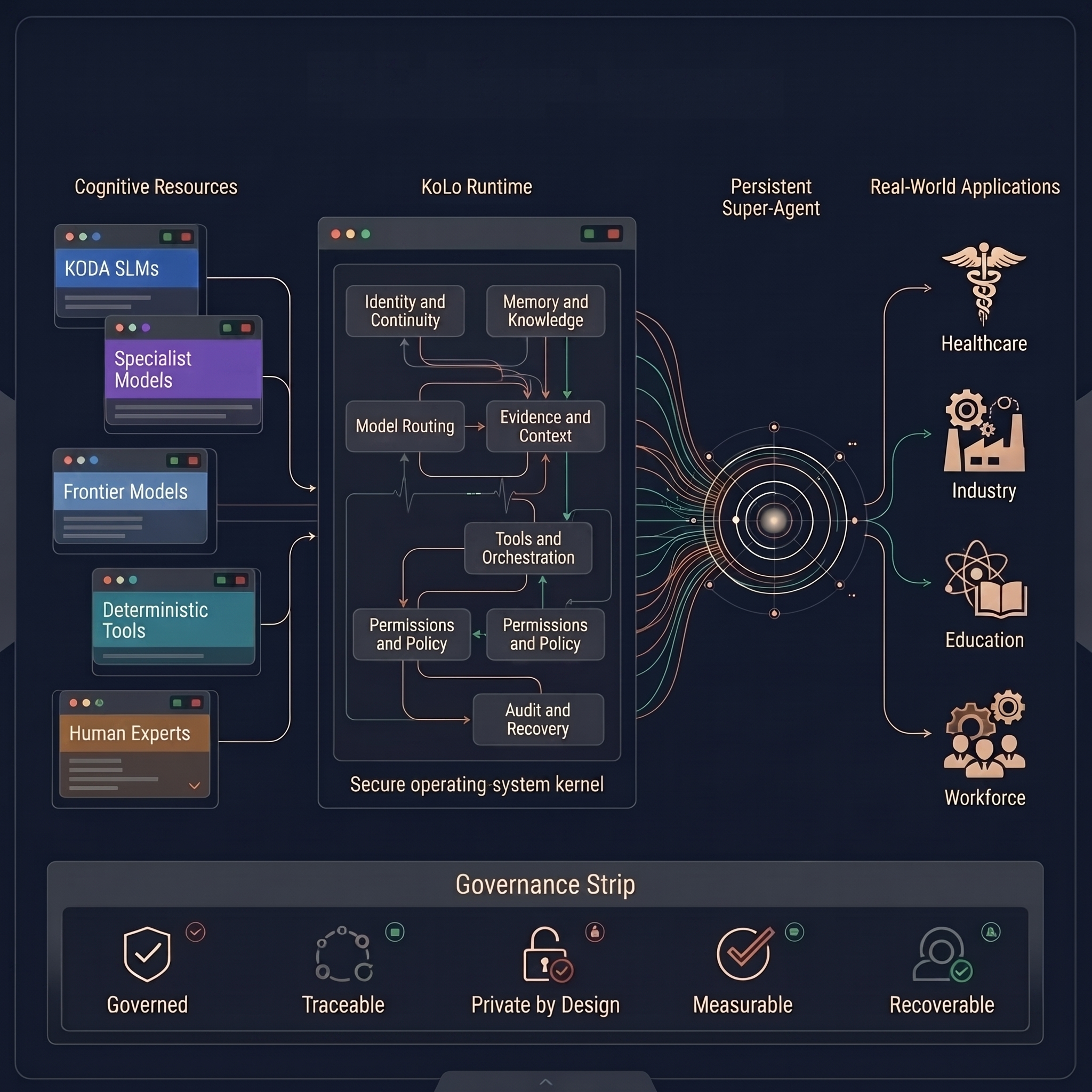
Models think. KoLo keeps everything around them continuous — identity, memory, permissions, audit and recovery live in a persistent runtime, and the model becomes one cognitive resource within it.
The agent keeps operating between invocations, swaps models without losing itself, keeps sensitive work local and preserves one audit lineage.
The agent owns the continuity. The models contribute cognition.
02 — FOUR OPERATING PLANES
One agent, four coordinated systems.
An autonomic body runs between thoughts; identity is reconstructed under governance; cognition is recruited per task; governance surrounds it all.
1. Autonomic plane
Keeps the system operational between thoughts — heartbeat and health, scheduling, memory consolidation, recovery, unresolved commitments. Most of this work requires no generative model.
2. Identity plane
Who the agent is authorised to be — constitutional anchors, defining relationships, Nyx-W behavioural posture, narrative and factual memory. Identity is reconstructed under governance, not stored entirely in one prompt, file or model.
3. Cognition plane
The intelligence for each task — KODA Reflex SLMs, specialist models, approved frontier models, deterministic software, human expertise. Several resources can combine while one operating identity persists.
4. Governance plane
Surrounds the complete system — access, evidence, model eligibility, human approval, audit, rollback. Governance determines whether, how and under what conditions cognition may run.
03 — IDENTITY ACROSS THREE LAYERS
Identity is reconstructed, not merely retrieved.
Identity is reconstructed from constitutional anchors, weight-borne posture and auditable memory. Anchors stay externally versioned; Nyx-W carries tendencies in weights; external memory keeps events, decisions and provenance inspectable.
Weights carry posture. Files carry truth. KoLo governs action. The research programme behind this separation: Project Nyx →
04 — THE GOVERNED REQUEST PATH
No request goes directly to an unrestricted model.
Govern first. Think second. Act last. Green marks the authorised route; red marks where the guardian blocks or escalates.
05 — INTELLIGENCE ASSEMBLY
Capabilities are composed, not improvised.
Foundation model
The underlying language and reasoning capability.
Speciality adapter
Domain knowledge for medicine, engineering, education or industrial operations.
Task adapter
A defined function — handover, classification, inspection, tutoring, document preparation.
Jurisdiction adapter
Country, regulatory, institutional or language-specific behaviour.
Nyx-W posture
Professional role, uncertainty discipline, escalation behaviour, constitutional orientation.
Evidence profile
Which knowledge sources, institutional documents and user records may be retrieved.
Tool permissions
Which systems and actions the capability may access.
Guardian policy
Which independent checks must pass before the result proceeds.
Human-approval rule
When an authorised person must approve the outcome.
Together these form a bounded capability — in healthcare, a Clinical Capability Capsule →; elsewhere, maintenance agents, tutors and safety reviewers. The architecture is reusable. The capability remains sector-specific.
06 — ONE TASK, MANY MINDS
Multi-model cognition without fragmented accountability.
A technician reports an unexpected vibration. Local classifier, retrieval, KODA specialist — frontier only if the pattern stays unfamiliar; an engineer approves, and KoLo records the complete route.
Several models contributed — yet the task remained one governed operation: one operating identity, one policy envelope, one evidence trail, one accountable outcome. That is the difference between model orchestration and a persistent KoLo agent.
07 — THE AGENT MESH
Independent identities, coordinated work.
A KoLo deployment holds named agents, bounded specialists, guardians and humans in one attributable mesh. Every delegation records initiator, scope, models used, review status and final ownership.
Complex collaboration does not require ambiguous accountability. Six named systems exist publicly; telemetry counts only daemon-resident peers — the distinction is stated in the benchmark registry →
08 — SUBSTRATE INDEPENDENCE
The same operating identity across different compute environments.
Edge
Small local models and deterministic systems — low latency, privacy, offline operation, predictable cost, equipment-level intelligence.
Institutional infrastructure
Private servers and controlled environments — organisational memory, specialist models, local evidence, internal tools, complete audit.
Frontier cloud
Approved frontier models — broad reasoning, novel problem solving, large-context synthesis. Governed external cognitive resources.
HPC
Training, distillation, simulation, large-scale evaluation, multi-agent experiments, benchmark execution.
Future substrates
Neuromorphic and biological compute may eventually contribute — still through defined interfaces, identity reconstruction, memory control, policy, audit and human governance.
The architecture does not assume today’s dominant model or hardware will remain permanent. The substrate is replaceable. Continuity is the architecture.
08b — MEMORY ORCHESTRATION
Substitution is a claim until something schedules the memory.
A replaceable substrate is an architectural intention. What makes it a physical property is a layer that decides, continuously, which parameters must be close to the processor and which can wait on storage.
Pin
Hold the always-active core resident. A cyclic scan defeats ordinary eviction policy, so the core is protected by construction rather than by luck.
Cache
Keep recently and recurrently selected parameters warm, without letting them crowd out the core.
Prefetch
Move what is likely to be selected next before it is asked for, so storage latency does not become response latency.
Evict
Release what is no longer earning its residency — and record why, so the policy can be examined rather than trusted.
Stream
Read the dormant majority from storage on demand, in its packed form, without an unpacking step that would multiply its size.
Place
Decide which processor socket owns which region, so that memory locality is a scheduling decision rather than an accident.
The orchestrator is model-independent by construction: it schedules residency without knowing which model it serves. Attention mechanisms differ between model families and are handled by adapters beneath it — but residency, eviction and prefetch do not change when the body changes. That separation is why a newer model, a smaller one, or one a jurisdiction requires can be adopted without disturbing the identity above.
The minds are selected. Something has to decide what is in the room.
09 — RECOVERY AND RECONSTRUCTION
Restarting a process is not enough.
After a crash, outage or model transition, KoLo reconstructs from constitutional state, versioned memory, unresolved tasks and checkpoints. Not a software restart — recovery of who the agent was, what it was doing and what happens next.
Recovery is part of identity continuity.
10 — ARCHITECTURAL BOUNDARIES
What the architecture does not claim.
It does not imply that every process requires a language model.
It does not imply that every task should be automated.
It does not imply that the largest model should always be selected.
It does not imply that more agents automatically create better intelligence.
It does not imply that model outputs should bypass professional review.
It does not imply that persistence guarantees factual accuracy.
It does not imply that identity continuity establishes consciousness.
It does not imply that a guardian removes the need for institutional governance.
The architecture structures persistent, multi-model, accountable systems. Safety and compliance still depend on intended use, model quality, testing and human responsibility.
The mind can change. The system must remain whole.
KoLo gives institutions one stable operating architecture across sovereign models, frontier cognition, tools, human authority and changing substrates. One identity. Many minds. One governed system.