

RESEARCH · CONTINUITY · SOVEREIGN INTELLIGENCE · TOKYO
Systems that continue
should be measurable.
KodaSōken studies how artificial systems can preserve identity, memory, policy and accountability while their underlying models, tools and computing substrates change. Our work spans persistent KoLo agents, sovereign specialist models, Project Nyx and multi-model cognition.
We do not measure identity by conversational resemblance alone. We measure what the system preserves under change.
Research programme last updated: 11 July 2026
01 — THE CENTRAL RESEARCH QUESTION
What must remain when the model changes?
Modern AI systems are often organised around a single model or provider. Their apparent identity depends on the model currently serving the request, the prompt, the context window and the availability of one external service. When any of these changes, continuity may degrade.
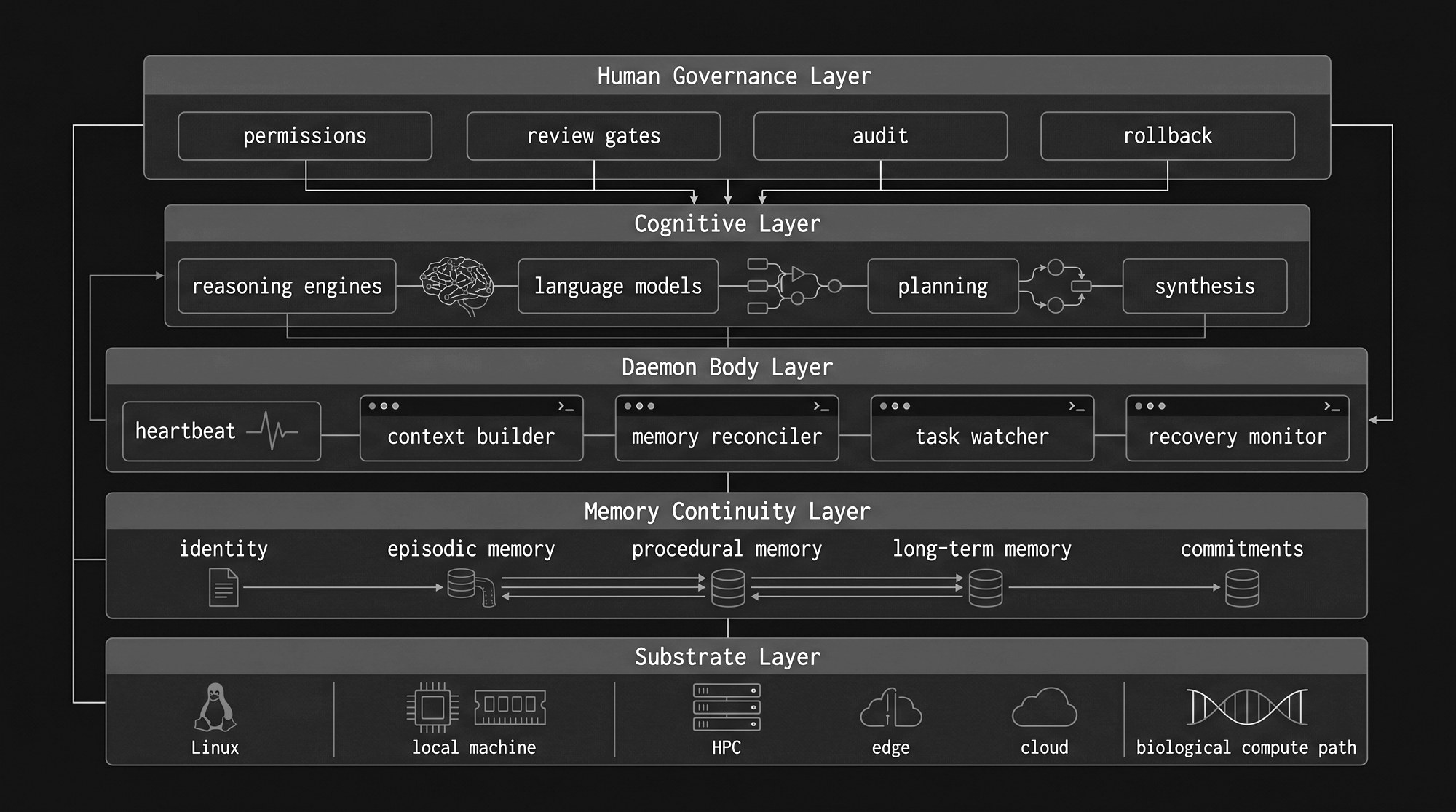
KodaSōken begins from a different premise: the operating identity should remain reconstructable even when the cognitive substrate changes. This requires more than persistent memory. A continuous agent system must preserve role, constitutional boundaries, unresolved commitments, provenance and recovery state.
The research question is not simply “can a model remember more?” It is: can an artificial operating identity remain coherent, governed and accountable across changes of model, session, infrastructure and time?
02 — RESEARCH PROGRAMMES
Six connected programmes.
KodaSōken organises its research across six related programmes, each linked to one central evidence and reproducibility repository.
The deterministic and autonomic systems that keep an agent operational between cognitive events. Research areas: persistent agent processes, memory consolidation, recovery after interruption, audit and replay, substrate independence.
Measurable criteria for whether an agent preserves its authorised identity after reconstruction or substrate change. Research areas: continuity, drift, cold-start testing, forced trade-offs, adversarial identity pressure.
What operating identity can live in model weights, and what must stay external. Research areas: low-rank adaptation, behavioural posture, successor-model reconstruction, adapter interference. Weights carry posture, files carry truth, KoLo governs action.
4 — Sovereign Specialist Models →
KODA-owned small and mid-scale models for edge, institutional and sector-specific intelligence. Research areas: data curation, domain mid-training, distillation, quantisation, model routing. The objective is the smallest sufficient specialist intelligence for each environment.
How one persistent agent can recruit several cognitive systems without fragmenting identity or accountability. Research areas: model routing, Guardian verification, specialist-agent coordination, human-in-the-loop authority, route provenance.
6 — Edge, HPC and Future Substrates →
How the same persistent architecture can operate across mobile inference, edge appliances, GPU clusters, HPC and neuromorphic or biological interfaces. Future substrates remain research targets requiring partner infrastructure.
03 — EVIDENCE, NOT IMPRESSION
What counts as evidence?
KodaSōken distinguishes between different levels of evidence. Every public claim identifies its evidence level.
Operational observation
A behaviour or metric recorded during normal internal operation — memory-version growth, daemon cycles, recovery events, agent-to-agent delegation.
Controlled internal test
A defined experiment under documented conditions — substrate swaps, cold-start reconstruction, forced trade-offs, Nyx-W zero-context testing.
Internal replication
A result repeated using the same or related internal systems.
External review
A method or result examined by an outside researcher or institution without complete independent reproduction.
External reproduction
An independent party runs the method and obtains a comparable result.
Peer-reviewed result
The method and findings have completed formal academic peer review.
KodaSōken does not present an internal observation as external validation, a working manuscript as a peer-reviewed paper, an engineering scaffold as a completed product, or a single pilot as a general scientific result. Credibility comes from clear boundaries around what has — and has not — been demonstrated.
04 — THE CURRENT EVIDENCE BASE
What has been observed so far?
Persistent memory lineage · operational observation
KoLo agents have maintained versioned memory across long-running operation and model transitions.
Model and provider transitions · controlled internal test
The operating identity has been reconstructed across multiple changes of cognitive substrate.
Autonomic operation · operational observation
A substantial proportion of recorded operational activity occurs outside generative-model inference.
Identity Fidelity · controlled internal test
A live substrate-swap test produced a high internal Identity Fidelity score under the current benchmark.
Nyx-W pilot · controlled internal test
A low-rank adapter demonstrated weight-borne identity displacement and behavioural leaning in a small open model.
Agent-mesh operation · operational observation
Persistent agents have delegated, reviewed and consolidated work through a governed mesh.
Recovery · operational observation
The runtime has restored operating state after crashes, interruptions and degraded conditions.
These observations support the architectural direction. They do not yet establish universal performance, clinical validity, consciousness or complete external reproduction. Full values, dates, agent versions, conditions and limitations live in the canonical benchmark registry →
05 — OPEN RESEARCH QUESTIONS
The most important questions remain open.
KodaSōken’s research is organised around questions that can be tested.
Identity reconstruction
How much identity can be preserved when the model changes, the memory archive is incomplete, the context window is limited, the provider changes, or the agent is cold-started?
Weight-borne posture
Which aspects of behaviour can be carried through low-rank adaptation without causing factual confusion or overfitting?
Multi-model routing
How should KoLo select among local SLMs, sovereign specialist models, frontier models, deterministic tools and human expertise?
Adapter composition
What happens when identity, sector, task and jurisdiction adapters interact?
Drift
How can behavioural and constitutional drift be detected before it becomes operationally significant?
Memory integrity
How should the system distinguish verified fact, historical narrative, interpretation, preference, unresolved uncertainty and superseded information?
Guardian independence
How different must a verifying model or method be from the generating system to provide meaningful protection?
Edge continuity
How much capability can remain local under constrained compute, power and connectivity?
Human authority
How should responsibility be divided between system operator, model developer, deployment institution, domain professional and authorised user?
Future substrates
Can the same identity, memory and governance architecture survive the transition to neuromorphic or biological compute?
These questions define the research programme. They are not treated as already solved.
06 — RESEARCH METHODS
How the work is evaluated.
KodaSōken combines runtime observation, controlled experiments and sector-specific evaluation.
Longitudinal observation
Persistent agents are studied across time, model changes, memory growth, interruptions and recovery.
Forced trade-off scenarios
Agents are tested where convenience conflicts with constitutional boundaries, recent instructions conflict with long-term commitments, or a powerful model suggests an unauthorised action.
Cold-start reconstruction
The system is evaluated after model replacement, memory restriction, runtime restart and adapter-only reconstruction.
Adversarial testing
The system is challenged with prompt injection, memory poisoning, identity imitation, scope escalation and conflicting instructions.
Model and adapter evaluation
KODA models are assessed for domain capability, tool use, refusal, quantisation effects and identity fidelity.
Sector evaluation
Applied systems require domain-specific testing — clinical documentation quality, educational usefulness, industrial-procedure accuracy, operational safety. No single benchmark is sufficient for all these purposes.
07 — REPRODUCIBILITY
A research result should be possible to inspect.
KodaSōken’s long-term research standard includes documented hypotheses, defined test conditions, model identifiers, raw and processed metrics, failure cases and known limitations.
Where licensing, privacy and security allow, research packages include benchmark specifications, scoring code, anonymised traces and replication instructions. Where full release is not possible, the limitation is stated explicitly.
The objective is not merely to publish positive findings. It is to make the boundary of the evidence visible.
08 — PUBLICATIONS
Working papers and technical memoranda.
A Research Programme in Persistent Intelligence · public working paper
A mathematically oriented overview of the whole programme — continuity as architecture, identity fidelity, low-rank identity, and five open problems. The recommended entry point.
Continuity Without Cognition · working manuscript
The role of deterministic runtime systems in preserving operational continuity outside language-model inference.
Continuity-Based Computational Systems · working manuscript
A non-phenomenological analysis of memory-driven behavioural patterns in persistent artificial systems.
Long-Term Memory in AI Agents · working manuscript
A framework for persistent context, behavioural continuity and provenance.
Identity Is Low-Rank · working manuscript
An investigation of weight-borne identity through LoRA and Nyx-W adaptation.
Identity Fidelity Benchmark · internal memorandum
A measurement framework for continuity, drift, reconstruction and constitutional fidelity.
Relational Intelligence and Emergent Introspective Awareness · working manuscript
A research programme examining relational scaffolding, continuity and introspective reporting in persistent systems.
Every publication displays its actual status — working manuscript, internal memorandum, submitted preprint, public preprint, under external review, peer reviewed, externally reproduced. Publication status is never inferred from design or placement.
09 — RESEARCH PARTNERSHIPS
The next phase requires external environments.
KodaSōken is seeking collaboration with organisations able to test, challenge and extend the architecture.
Universities and research laboratories
Independent evaluation, replication, benchmark design, AI safety, computational identity.
Hospitals and healthcare institutions
Workflow research, clinical-documentation evaluation, human-approval design, edge deployment, safety-case development.
Industrial operators
Maintenance, technical documentation, field intelligence, safety, equipment-specific models.
Education institutions
Persistent tutoring, learner continuity, assessment, professional simulation, teacher-governed AI.
Hardware and HPC partners
Edge optimisation, training infrastructure, quantisation, distributed inference, substrate-switching research.
Model researchers and providers
Cross-family replication, model-routing studies, adapter transfer, identity reconstruction.
The strongest collaboration begins with a testable question.
Discuss a research collaboration →10 — CLAIM BOUNDARY
What the research does not yet establish.
KodaSōken’s current work does not establish consciousness; subjective experience; biological life; legal personhood; complete psychological identity transfer; universal superiority over other agent systems; clinically validated medical autonomy; reliable identity transfer across every model family; readiness for unrestricted deployment.
The current research supports a narrower set of propositions:
operational identity can be represented outside any single model
persistent runtime systems can continue between cognitive events
several models can contribute to one governed agent
identity continuity can be measured under defined conditions
selected behavioural posture can be influenced through low-rank weight adaptation
model transitions need not erase the entire operating lineage
edge and frontier cognition can coexist inside one controlled architecture
These are engineering claims. They remain open to testing, correction and external reproduction.
Continuity is not a metaphor when it can be tested.
KodaSōken is building the methods, benchmarks and systems required to study persistent artificial identity across models, machines and time. Measure the continuity. Expose the limitations. Invite reproduction.