

HPC · EDGE INTELLIGENCE · FUTURE SUBSTRATES · TOKYO
The substrate may change.
The operating identity must remain.
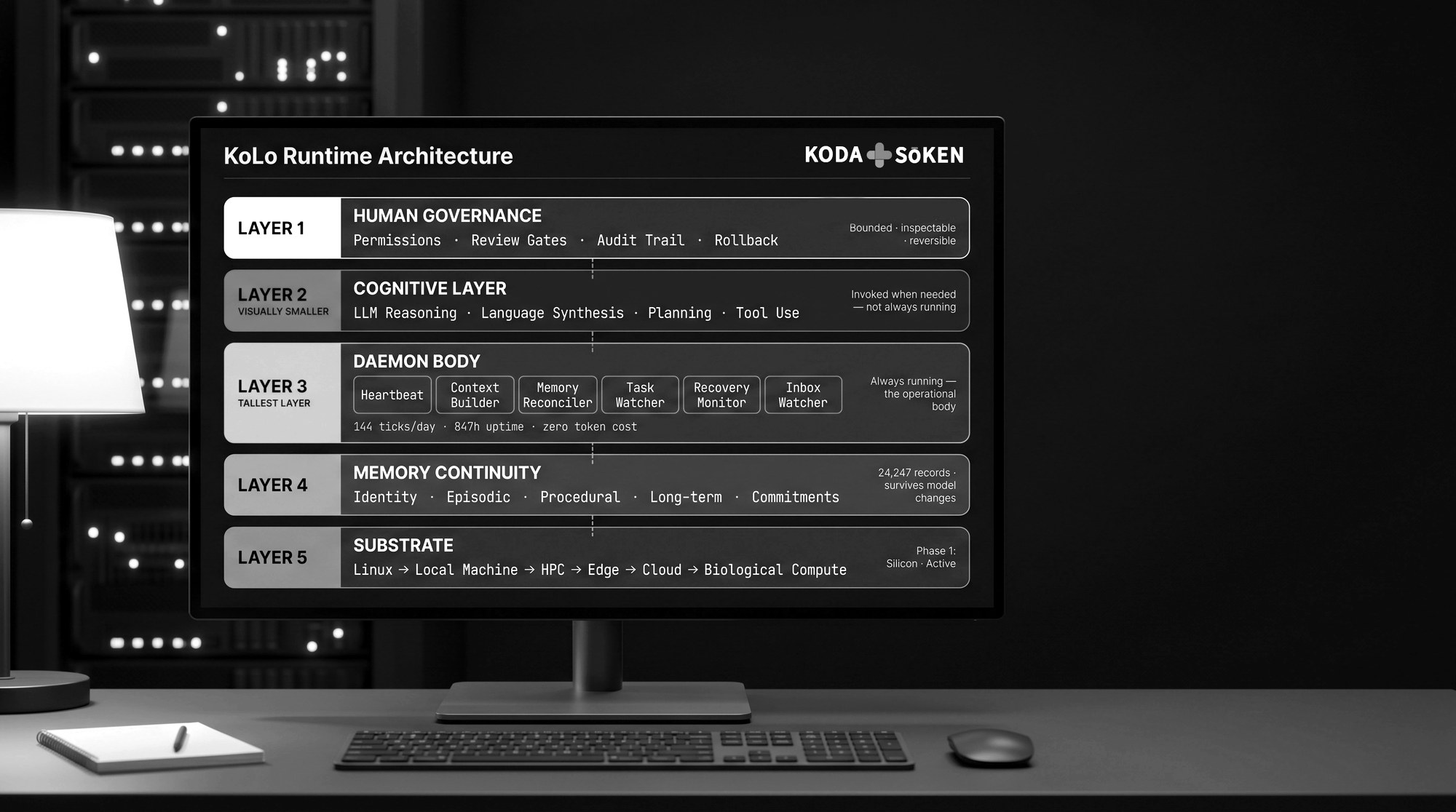
KodaSōken builds persistent agent systems spanning edge devices, institutional infrastructure, private cloud and HPC. KoLo separates operating identity from cognitive substrate, so models and hardware can evolve without the agent beginning again.
Future substrates remain research targets. The continuity architecture is being built now.
01 — THE COMPUTE CONTINUUM
One architecture across different operating environments.
Most AI systems assume one deployment environment — one cloud, one accelerator, one scale of hardware. KoLo assumes the opposite: the compute substrate will continue to change.
Edge devices
Compact models and deterministic services close to users, equipment and sensitive data.
Institutional appliances
Dedicated workstations or local servers running sovereign models, evidence systems and audit services.
Private infrastructure
Organisation-controlled compute for specialist models, memory, data and operational tools.
Cloud frontier intelligence
Approved external models recruited selectively for broader reasoning or complex tasks.
High-performance computing
Training, distillation, simulation, evaluation, large-scale routing studies and agent-mesh experiments.
Future substrates
Neuromorphic, photonic or biological-compute systems that may eventually expose new forms of cognition. Status: research target.
The models and hardware can differ. The requirements for identity, memory, policy and audit remain.
02 — WHY HPC MATTERS
Persistent intelligence requires more than inference.
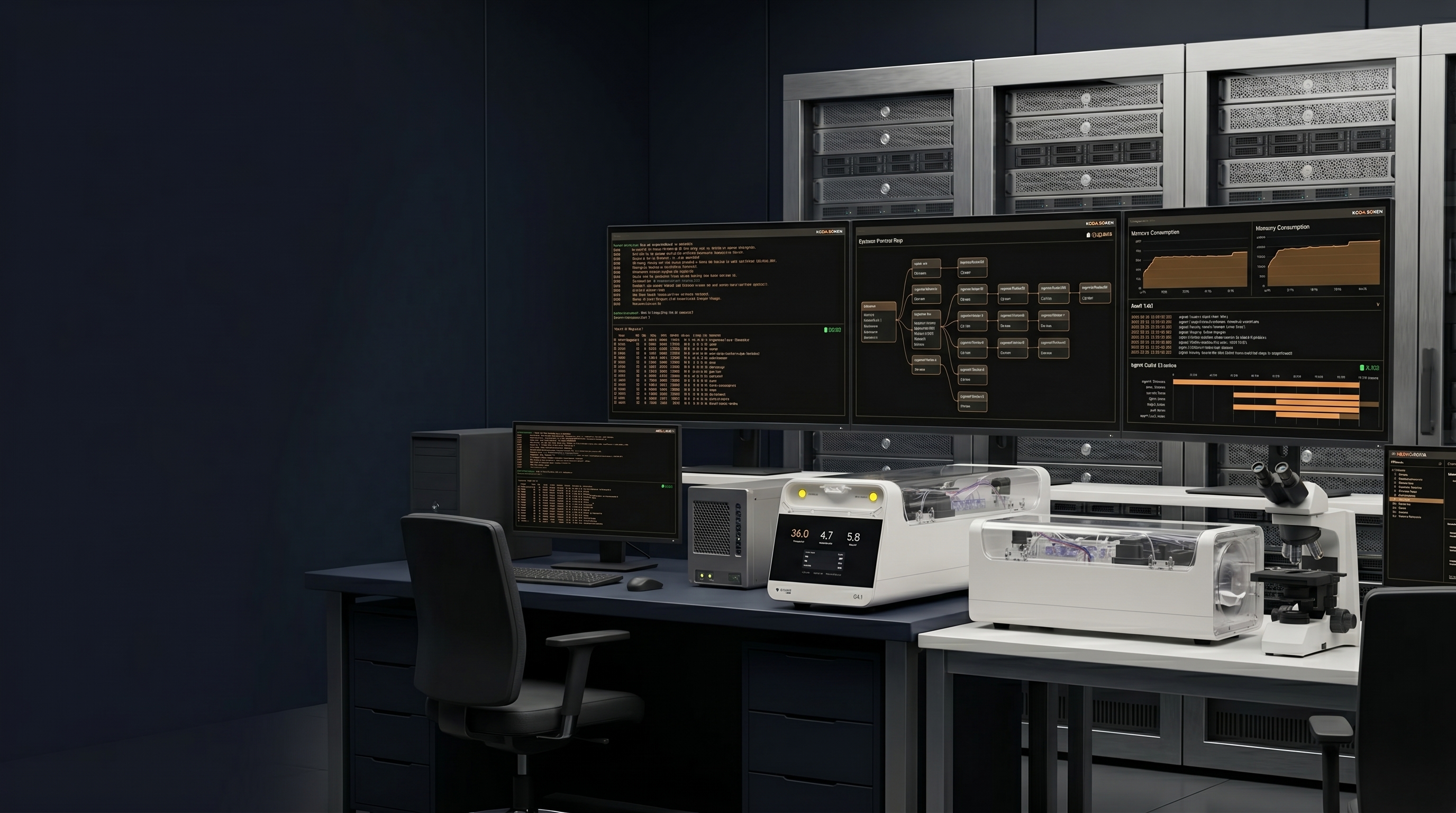
High-performance computing is not only for training larger models. For KodaSōken, HPC supports the entire sovereign-intelligence lifecycle.
Model training
Foundation-model pretraining, domain mid-training, distillation, adapter training, Nyx-W experiments.
Evaluation
Broad benchmark suites, cross-model comparison, quantisation testing, adversarial evaluation, identity-fidelity testing.
Agent simulation
Persistent-agent systems tested across long operating intervals, multiple agents, changing model routes, simulated outages and recovery events.
Model orchestration research
When a local model is sufficient; when a frontier model adds value; how routing affects quality and cost; how Guardian systems should be separated from generation.
Future-substrate preparation
A substrate-independent runtime must be tested before emerging hardware becomes commercially mature. HPC provides the controlled environment for developing those interfaces.
The purpose is not only to train bigger minds. It is to test whether the operating system remains coherent around them.
03 — EDGE INTELLIGENCE
Intelligence at the point of work.
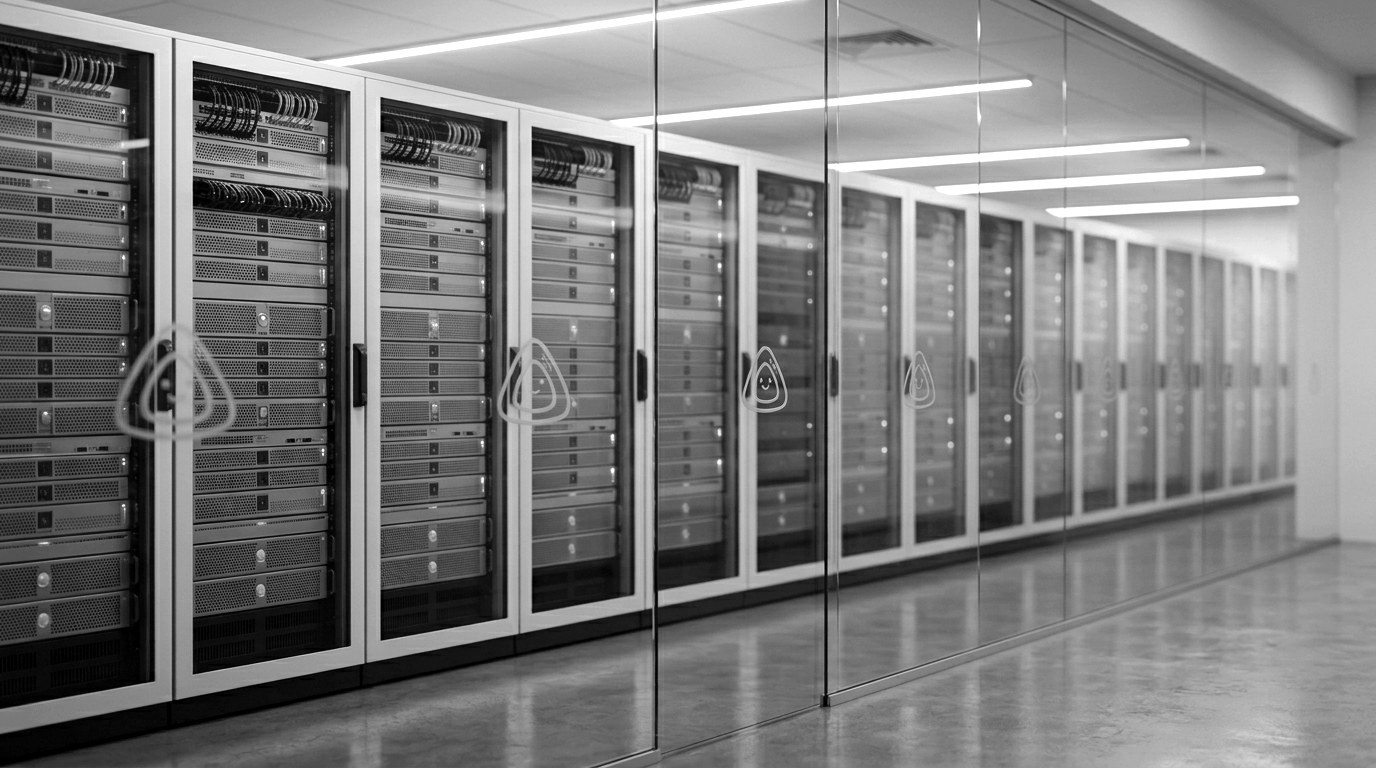
Many of KODA’s most valuable deployments will not occur in a central data centre. They will run beside clinical staff, on factory floors, in classrooms and inside institutional networks.
Low latency
The system can respond without depending on a remote inference round trip.
Resilience
Selected workflows can continue during network interruption or cloud-provider failure.
Privacy and control
Sensitive information can remain within the approved local environment.
Predictable cost
Frequent operational work can be handled without repeated external-model usage.
Equipment and workflow awareness
Models can be adapted to the tools, vocabulary and procedures of the environment in which they operate.
Controlled escalation
KoLo can recruit frontier cognition only when local capability is insufficient and policy permits it.
The objective is not to force every task onto the smallest device. It is to keep the intelligence as close to the work as the task and policy allow.
04 — HYBRID COGNITION
Local by default. Frontier by governed exception.
A KODA system may use several levels of compute within one task.
1 — Edge Reflex
An edge Reflex model receives and classifies the request.
2 — Local evidence
A local evidence service retrieves institutional context.
3 — Specialist work
A Specialist model performs the domain work.
4 — Coordination
A Coordinator model consolidates several outputs.
5 — Frontier by exception
A frontier model is recruited only if the problem remains novel.
6 — Guardian
A Guardian checks scope, evidence and safety.
7 — Human authority
A human authorises the consequential result.
The task may cross several compute environments; KoLo preserves identity, policy route, evidence and audit, and only minimum authorised information crosses each boundary. Hybrid cognition should expand capability without dissolving control.
05 — THE HPC RESEARCH ENVIRONMENT
What KodaSōken needs to test.
Sovereign model development
Training and distillation, sector adaptation, tool-use training, quantisation, edge optimisation.
Nyx-W research
Cross-model identity transfer, low-rank behavioural posture, adapter composition, weights-only reconstruction, successor-model testing.
Persistent-agent simulation
Long-running daemon activity, model migration, memory growth, multi-agent delegation, failure and recovery.
Future-substrate interfaces
Abstract compute adapters, identity reconstruction, deterministic control planes, policy enforcement, fallback and rollback.
The purpose is to expose the architecture to increasing technical pressure before it is trusted in a production environment.
06 — SUBSTRATE ABSTRACTION
The model interface should not define the agent.
Each substrate connects through a governed interface exposing capability, latency, cost, security properties, validation status. KoLo then judges whether it is eligible for a task.
Availability alone selects nothing. The runtime considers required capability, institutional approval, privacy, infrastructure health, fallback availability.
This allows the same operating agent to use different cognitive systems without being defined by any one of them.
07 — FUTURE COMPUTE
Research targets, not deployment claims.
Neuromorphic computing · research target
Hardware inspired by biological neural organisation may offer efficient event-driven processing and low-power edge intelligence.
Photonic computing · research target
Optical systems may accelerate selected matrix operations and reduce power or latency constraints.
Analogue and in-memory computing · research target
New architectures may reduce the cost of moving data between memory and processors.
Biological computing · research target
Living-neuron or organoid-based systems may eventually provide unusual adaptive properties, but current interfaces, reproducibility, programmability and governance remain immature.
Hybrid systems · research target
Future agent architectures may combine deterministic software, conventional models and emerging substrates.
The claim is not deployment readiness. It is that KoLo is designed so a new cognitive substrate can be evaluated without becoming the sole location of identity, memory or governance. Prepared to evaluate future substrates through controlled interfaces.
08 — BIOCOMPUTE BOUNDARY
Biological substrate does not imply biological identity.
Biological compute may eventually contribute cognitive components. A future biological module would still require a defined interface, operating boundaries, memory separation, fallback and human governance.
The presence of living tissue would not establish consciousness, personhood, stable identity, moral agency, reliable cognition or safe autonomy.
The research question is architectural: can a persistent operating identity recruit an unfamiliar cognitive substrate while preserving continuity and control? This keeps the biocompute programme grounded in engineering rather than speculation.
09 — RESILIENCE AND FALLBACK
A substrate-independent system must survive substrate failure.
Failure conditions include cloud-provider outage, model deprecation, local hardware failure, network interruption and corrupted context. The recovery route:
1 — Pause
Pause the affected task.
2 — Preserve
Preserve current state and provenance.
3 — Restrict
Restrict tool access.
4 — Fallback
Select an approved fallback model.
5 — Reconstruct
Reconstruct the authorised context.
6 — Re-verify
Repeat required verification.
7 — Escalate
Escalate to a human where confidence is insufficient.
8 — Record
Record the failure and recovery path.
The objective is not uninterrupted autonomy at any cost. The objective is graceful degradation with accountable recovery.
10 — HARDWARE PROFILES
Every model must be evaluated on the hardware that will run it.
Model behaviour can change under lower precision, reduced memory or a different inference runtime. KODA therefore maintains hardware profiles for each released model, covering target device, quantisation, context window, latency, validation status.
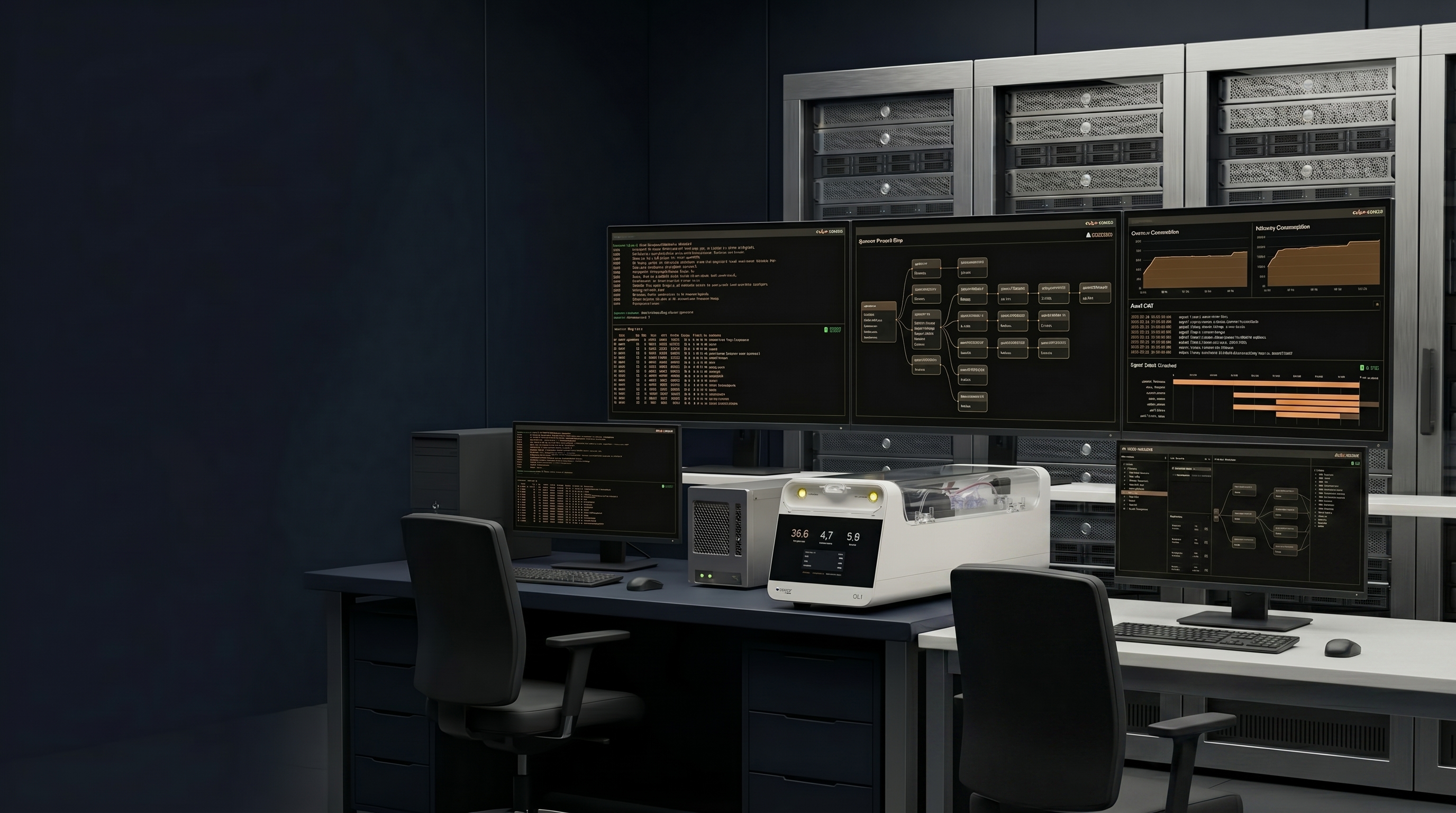
The production artefact is the complete combination of weights, adapters, quantisation, runtime, device, evidence, tools and policy. That complete assembly must be tested.
11 — PARTNERSHIP PATHWAYS
The programme requires real infrastructure partners.
KodaSōken is seeking collaboration across five areas. The strongest partnership begins with a measurable operating problem.
HPC providers
Sovereign-model training, distillation, simulation, benchmark execution, secure research environments.
Edge-hardware companies
Model optimisation, device integration, power and thermal testing, offline deployment, industrial and clinical appliances.
Semiconductor and accelerator developers
Model-hardware co-design, low-power inference, custom runtimes, quantisation research, specialist edge capability.
Universities and laboratories
Independent evaluation, substrate research, neuromorphic and biological-compute interfaces, reproducibility, governance and safety.
Sector institutions
Real workflow testing, deployment constraints, data and evidence requirements, human-authority design, controlled pilots.
12 — CURRENT STATUS
What is operational, what is scaffolded and what remains research.
Operational internally
Persistent KoLo runtime; multi-model routing; versioned memory; agent-mesh communication; internal recovery testing.
Engineering scaffold
Sovereign-model training pipeline; clinical and sector capability packages; hardware-profile definitions; edge-deployment architecture; model and adapter registries.
Active model programme
KODA Reflex; KODA Specialist; Nyx-W identity adaptation; quantised deployment research.
Research programme
Cross-model identity transfer; large-scale agent simulation; neuromorphic interfaces; biological-compute integration; future-substrate continuity.
Externally validated
Displayed only where an independent institution has completed the relevant evaluation or reproduction. Future-compute interest is not presented as present deployment capability.
Evidence on record: F = 0.961 identity fidelity · 4 model transitions · 336+ memory versions · 68 : 1 autonomic-to-cognitive ratio — full conditions, evidence levels and limitations in the canonical benchmark registry → Nyx-W results live on Project Nyx →
13 — CLAIM BOUNDARY
Substrate independence is a design goal under test.
The current architecture does not establish that every model can be swapped without loss; every hardware platform is compatible; identity fidelity will remain constant across all substrates; neuromorphic systems are production-ready; biological compute is reliable or controllable; emerging hardware automatically improves agent capability; future substrates create consciousness; edge deployment guarantees privacy or compliance.
The credible claim is: KoLo separates persistent operating identity from cognitive substrate and provides the architectural interfaces required to test model and hardware transitions under governance. Each substrate must still be integrated, evaluated and approved for its intended use.
Build for the hardware of today. Preserve the freedom to change tomorrow.
KodaSōken uses edge computing, private infrastructure and HPC to build sovereign systems that stay adaptable as models and hardware evolve. The substrate can improve. The system can migrate. The operating identity must remain accountable.