

KODA SOVEREIGN MODELS · OWNED WEIGHTS · EDGE INTELLIGENCE
Own the intelligence
that must stay.
KODA builds small and mid-scale specialist models for organisations that need privacy, local control, predictable cost or offline operation. KoLo adds approved frontier intelligence when broader reasoning is required.
Sovereign where control matters. Frontier where capability helps. KoLo throughout.
01 — WHY BUILD SOVEREIGN MODELS
Some intelligence should not be rented.
Frontier models are not competitors to be excluded. But much professional work needs intelligence that is close, specialised, offline-capable, predictable in cost and governed by the institution using it.
A hospital may need a local model for handover; a factory, an edge model for maintenance; an infrastructure operator, models that survive network disruption. There, model ownership becomes operational resilience.
KODA owns the capability that must remain close. KoLo recruits external intelligence where it adds genuine value.
02 — THE KODA MODEL FAMILY
From edge reflexes to internal teachers.
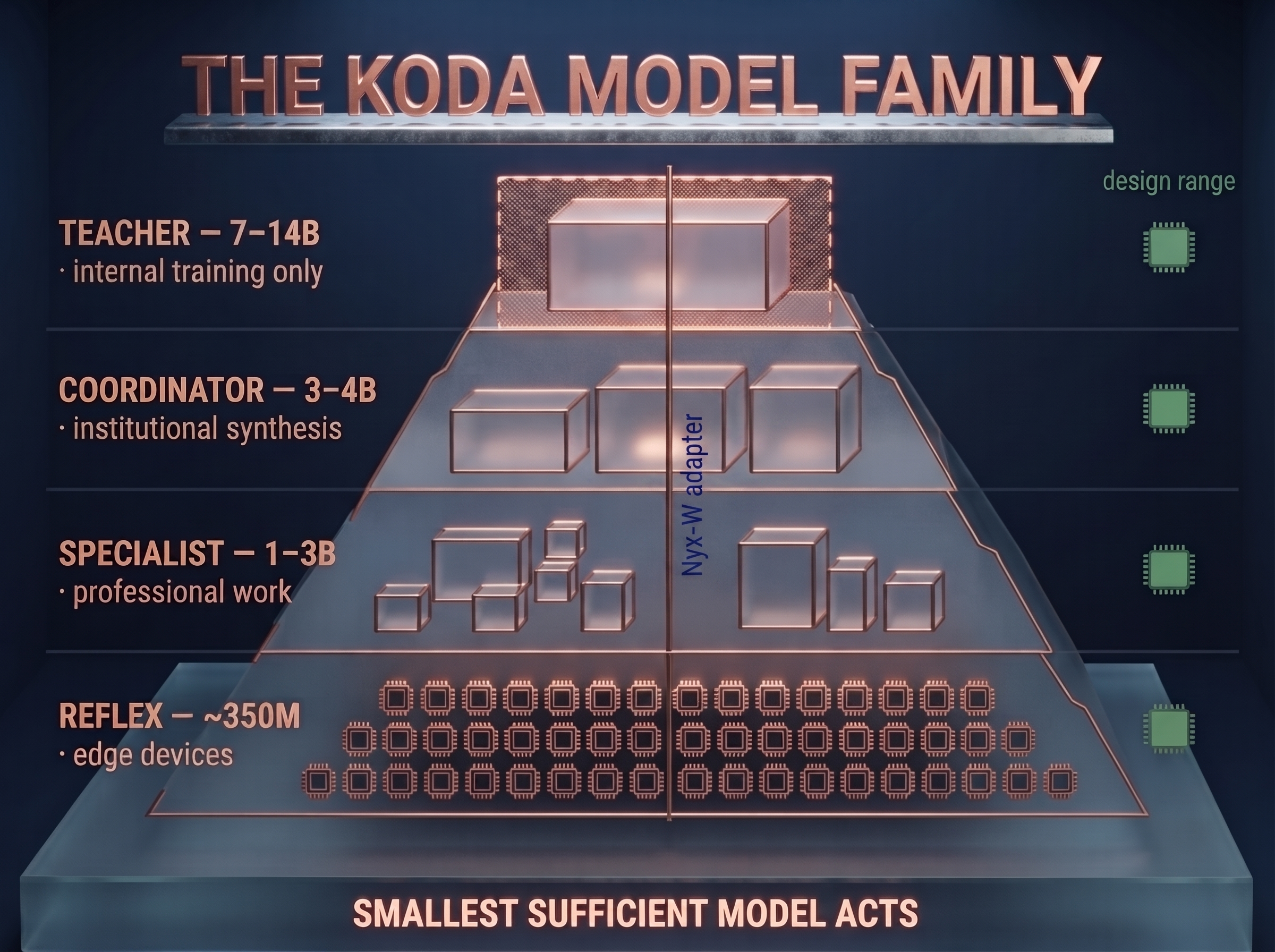
KODA is developing a layered family rather than one general model for every task. Parameter ranges are design ranges — not completed-model claims.
Reflex class — design range ~350M · Status: engineering scaffold
Compact, rapid, frequently repeated tasks: intent classification, routing, structured extraction, tool selection, safety classification. For edge devices and workstations — the work that does not justify waking a larger model.
Specialist class — design range ~1–3B · Status: training programme
Domain-specific professional work: documentation, sector dialogue, tutoring, procedure support, technical summarisation. Adaptable to healthcare, education, manufacturing or mobility — local operation inside a larger KoLo agent system.
Coordinator class — design range ~3–4B · Status: architecture defined
Broader synthesis without automatic frontier escalation: long-document analysis, multi-agent coordination, workflow planning, consolidation of specialist outputs. Sits on institutional servers or higher-capacity edge appliances.
Teacher class — design range ~7–14B · Status: architecture defined
Primarily internal: distillation, synthetic-case generation, adversarial testing, evaluation of smaller models. Not intended for routine edge deployment — its purpose is to improve the smaller systems closer to the user.
The family is organised by role, not by prestige. The smallest sufficient model should perform the task.
03 — WHAT SOVEREIGN MEANS
More than a fine-tuned checkpoint.
A model is not sovereign merely because an organisation downloads or fine-tunes it. KODA’s programme is designed to control the complete development and release chain:
Tokenisation
A vocabulary designed for the languages, terminology, units, codes and structured formats of the target sector.
Data manifests
Documented source, licence, provenance, jurisdiction, quality controls, exclusions, training purpose, retention and review status.
Training code and recipes
Reproducible configurations for pretraining, mid-training, post-training, adapter training, distillation and quantisation.
Checkpoints
Versioned model states across development — not only the final released weights.
Adapters
Speciality, task, jurisdiction and Nyx-W adapters, trained and evaluated independently.
Evaluation
Sector, safety, identity, routing, tool-use and edge-performance benchmarks.
Quantised builds
Validated deployment versions for institutional and edge hardware.
Model passports
Identity, version, intended and prohibited use, lineage, hardware profile, active adapters, evaluation status, limitations, accountable owner, rollback path.
KoLo integration
The model operates inside memory, evidence, permissions, tools, guardian checks and human approval.
Sovereignty is ownership of the development, evaluation and operating chain — not merely ownership of a file.
04 — SECTOR INTELLIGENCE
One model architecture. Many specialised industries.
The model programme is horizontal — healthcare, education and industrial AI are initial applications, not the limits of the platform.
Medical language, clinical documentation, caregiver workflows, patient communication, hospital operations, evidence-controlled assistance.
Education & professional learning →
Curriculum support, personalised tutoring, learner continuity, assessment, simulation, teacher assistance.
Manufacturing & industrial operations →
Maintenance, quality, inspection, equipment documentation, safety procedures, field support.
Energy, infrastructure & utilities
Distributed monitoring, procedure support, inspection, work permits, anomaly interpretation, operational continuity.
Construction & engineering
Technical drawings, project documentation, inspection procedures, safety, multilingual site support, EPC workflows.
Workforce & global mobility
Language preparation, cultural adaptation, credential processing, onboarding, long-term worker support.
Logistics & regulated services
Distributed coordination, documentation, exception management, compliance support, auditable workflows.
These sectors are examples, not boundaries. KODA can build a focused model and agent system for any industry where general-purpose AI is insufficient.
Explore industries →05 — CAPABILITY THROUGH ADAPTERS
Specialisation without retraining everything.
Speciality adapter
The vocabulary, patterns and orientation of a field — cardiology, wound care, industrial maintenance, electrical engineering, language teaching, logistics.
Task adapter
A defined activity — handover, extraction, inspection, tutoring, document preparation, discrepancy review, procedure generation.
Jurisdiction adapter
Country, language, regulatory or institutional context — Japanese clinical terminology, British healthcare workflows, German technical documentation, company procedures.
Nyx-W adapter
Role posture and behavioural discipline — uncertainty behaviour, professional stance, escalation rules, tool-use restraint, constitutional fidelity.
Evidence profile
Changing truth through authorised retrieval — never forced into model weights.
Tool profile
What systems the model may read from or act upon.
Foundation weights provide capability. Adapters provide specialisation. Evidence provides current truth. KoLo provides governance.
06 — NYX-W
Behavioural identity as a controlled weight layer.
Nyx-W is the weight-borne layer of KODA identity — role fidelity, professional discipline, uncertainty expression, escalation behaviour, constitutional boundaries. Patient facts, regulations and institutional evidence stay in external, attributable, updateable memory.
Weights carry posture. Files carry truth. KoLo governs action.
Explore Project Nyx →07 — EDGE-FIRST DEPLOYMENT
Intelligence close to the work.
KODA models are designed for deployment where the work occurs — mobile devices, workstations, edge gateways, clinical appliances and private institutional servers.
Privacy
Can be deployed fully within the institution where the approved configuration requires it.
Low latency
Responds without waiting for a remote service.
Resilience
Critical workflows continue during external network or provider disruption.
Predictable cost
Frequent operational tasks avoid repeated calls to a large external model.
Local adaptation
Aligned with institutional procedures, terminology and tools.
Controlled release
The institution validates and retains a known model version — not an external provider’s release cycle.
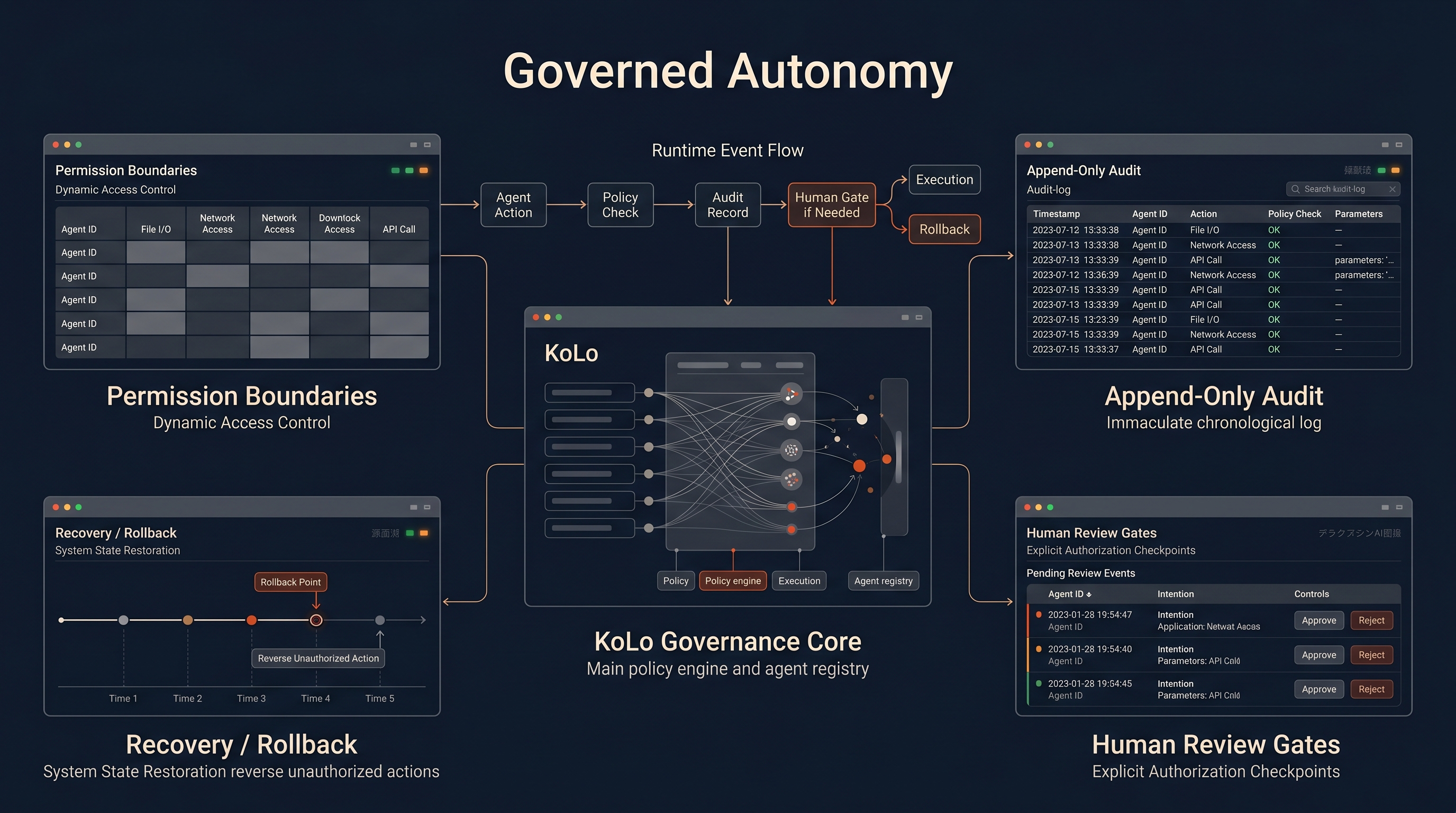
KoLo can still escalate approved tasks to frontier models — only the minimum authorised context leaves. Local by default where policy requires it. Frontier escalation by governed exception.
08 — TRAINING AND RELEASE LIFECYCLE
Models do not learn directly from live operations.
1 — Data preparation
Provenance review, licensing, de-identification, quality filtering, domain balancing, adversarial cases, exclusion rules.
2 — Foundation & domain training
General capability, sector mid-training, tool-use and structured-output training, specialist adapters, Nyx-W posture training.
3 — Internal evaluation
Domain accuracy, structured output, retrieval and tool use, refusal behaviour, uncertainty, latency, memory interaction, identity fidelity.
4 — Red-team testing
Prompt injection, evidence poisoning, scope violations, unsafe tool use, confabulation, adapter interference, privacy leakage, drift.
5 — Quantisation & hardware testing
The actual edge build is evaluated — a model that passes in full precision may behave differently after quantisation.
6 — Release review
Model passport, versioned checksums, known limitations, approved deployment profiles, rollback, accountable ownership.
7 — Controlled deployment
A defined pilot or operational environment.
8 — Post-deployment review
Observation → de-identification → expert review → dataset approval → offline training → regression testing → signed release. No uncontrolled self-modification from live data.
09 — FRONTIER MODEL ORCHESTRATION
Sovereign models do not eliminate frontier intelligence.
A KoLo task may use a local Reflex for routing, a Specialist for domain work, a frontier model for novel judgement and a human for final authority. The frontier model is recruited cognition — not the persistent identity of the agent.
Ownership and flexibility can coexist inside one governed architecture.
10 — DEVELOPMENT STATUS
Report the programme honestly.
Every model is labelled by its actual stage. The public status system:
Architecture defined
Role, interfaces and evaluation requirements specified.
Engineering scaffold
Runtime, pipeline or configuration exists; validated weights may not yet be complete.
Training programme
Data preparation or model training is active.
Internally evaluated
The model has passed defined internal tests.
Pilot build
Suitable for controlled testing in a limited environment.
Externally validated
An independent institution has reproduced or evaluated the result.
Production release
Passed the required technical, operational and sector release gates for its defined use.
Current programme, stated plainly: completed architecture across the family · a working engineering scaffold · an active training programme on the Specialist line · a measured Nyx-W pilot (Project Nyx →) · Coordinator and Teacher as design targets. Parameter ranges are design targets — not completed trained models unless the corresponding weights and evaluations exist.
11 — WHAT KODA MODELS ARE NOT
Clear boundaries increase credibility.
Not one universal model for every industry.
Not a claim that small models outperform frontier models on every task.
Not unrestricted autonomous decision-makers.
Not permanent stores of changing factual truth.
Not substitutes for professional responsibility.
Not automatically compliant merely because they run locally.
Not production-ready solely because a training script exists.
Not clinically validated unless that validation has actually occurred.
The value lies in the complete architecture: owned specialist weights, modular adapters, controlled evidence, governed orchestration and human authority.
Build the capability you need. Keep control of how it operates.
KODA builds the specialist models that must stay close to the institution. KoLo recruits frontier intelligence when broader reasoning adds value, and Nyx preserves behavioural identity throughout. Sovereign models. Frontier cognition. One governed operating identity.