

INDUSTRIES · SOVEREIGN SECTOR INTELLIGENCE · TOKYO
One architecture.
Any specialised industry.
KodaSōken creates focused intelligence systems for sectors where general-purpose AI is not enough. One architecture: KODA-owned specialist models, approved frontier intelligence, persistent KoLo agents, controlled evidence and human governance.
It can be adapted to industries requiring specialist language; proprietary knowledge; edge computing; privacy; governed action.
Healthcare, education and industrial AI are initial applications — not the limits of the platform.
01 — THE SECTOR-INTELLIGENCE PRINCIPLE
The architecture is horizontal. The capabilities are vertical.
Most industries do not need another general chatbot. They need intelligence that understands the profession’s terminology, the institution’s procedures, its evidence and jurisdiction — and when a human must remain in authority.
KodaSōken provides one reusable sovereign-agent architecture, specialised per sector on a consistent KoLo Runtime — KODA sovereign models, sector adapters, controlled eRAG, Guardian verification, human approval. The result is not a generic assistant with an industry prompt — it is a bounded, governed capability designed around the reality of the work.
The core architecture is reusable. The deployed intelligence is sector-specific. See the architecture →
02 — WHY GENERAL-PURPOSE AI IS NOT ENOUGH
Professional work has its own language, evidence and consequences.
Frontier models provide powerful general reasoning. But specialised work depends on information a general model cannot safely infer: internal procedures, technical specifications, professional terminology, current evidence and approval requirements.
A hospital, factory, school and construction project do not need the same model assembly. KoLo assembles intelligence per industry, institution, task and operating boundary: a compact local model, a sector-specific model, local evidence, an independent Guardian, a human decision-maker.
Several forms of intelligence may contribute. The institution retains one governed and auditable operating system.
03 — THE REUSABLE INDUSTRY STACK
From model weights to accountable action.
A KODA sector system can be assembled through nine controlled layers.
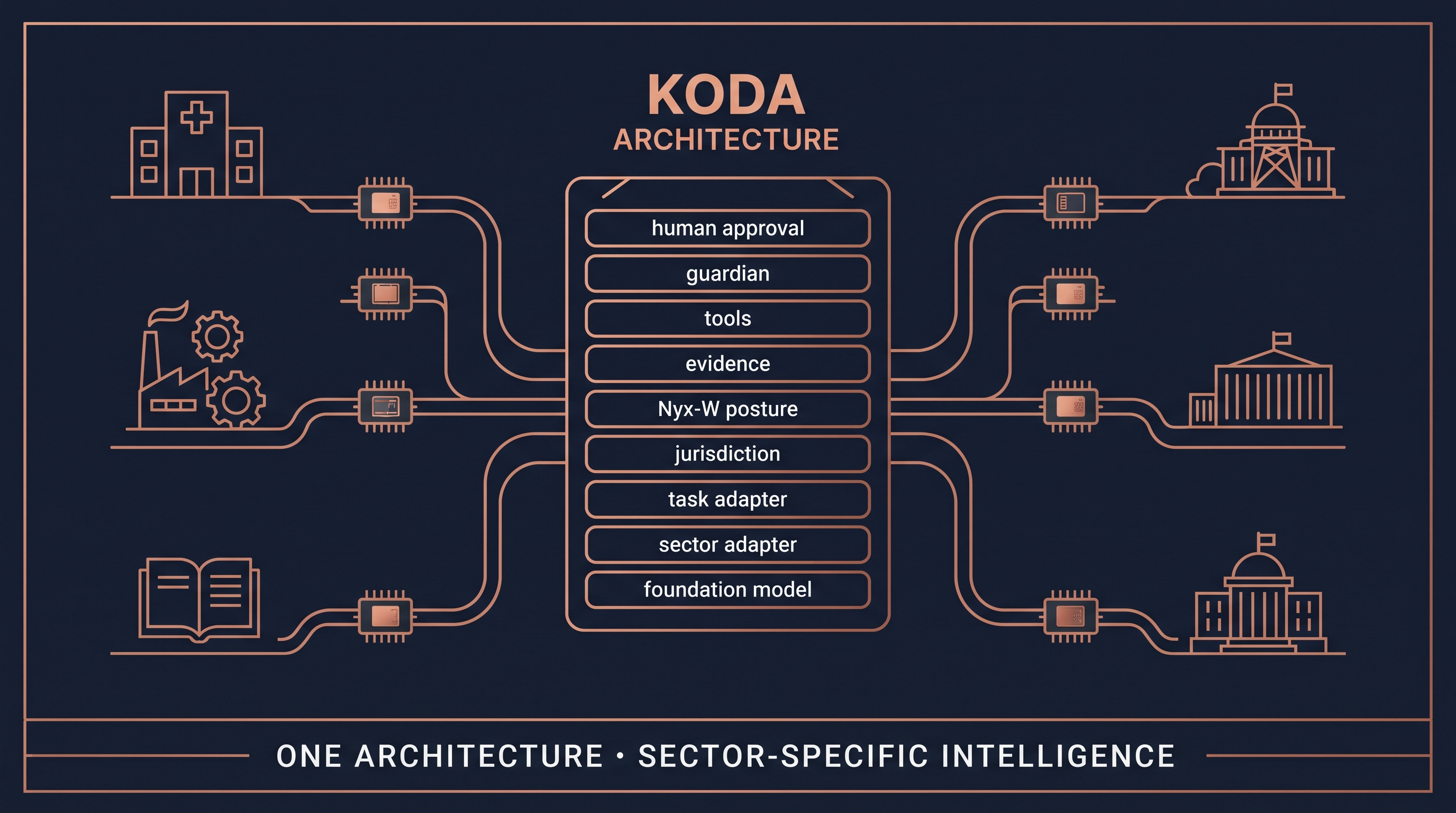
1 — Foundation intelligence
A KODA Reflex, Specialist or Coordinator model provides the base cognitive capability.
2 — Sector adaptation
Speciality adapters add the language, concepts and professional patterns of the industry.
3 — Task adaptation
Task adapters support functions such as inspection, documentation, tutoring, procedure support and workflow coordination.
4 — Jurisdiction and institution
Adapters and policies align the system with country, regulation, institutional procedure and local terminology.
5 — Nyx-W professional posture
Nyx-W can carry role fidelity, uncertainty discipline, escalation behaviour and constitutional boundaries.
6 — Controlled evidence
eRAG retrieves authorised and attributable information from technical manuals, policies, institutional records and case context.
7 — Operational tools
The system connects to the equipment, software and workflows required to perform the task.
8 — Verification and human authority
Guardian agents and approval gates check scope, evidence, uncertainty and risk before consequential action.
9 — KoLo continuity and audit
KoLo preserves identity, memory, policy, model route, approval and recovery.
This common stack can support many sectors without forcing every deployment into the same model or workflow. Built on KoLo Runtime →
04 — INITIAL INDUSTRY PATHWAYS
Starting points, not boundaries.
Current status: Engineering scaffold, applied-product development and active model programme
KODA Kenkō combines sovereign medical models, clinical capability agents, controlled evidence and clinician authority. Potential capabilities: clinical documentation, nursing handover, medication discrepancy review, professional education, multilingual workflows.
Education & professional learning →
Current status: Architecture programme and applied-platform development
Persistent learner systems can preserve context across lessons, assessments and professional development. Potential capabilities: personalised tutoring, multilingual education, learner assessment, skills simulation, teacher assistance. The teacher or institution retains educational authority.
Manufacturing & industrial AI →
Current status: Sector architecture and partner-development pathway
Edge-deployed intelligence can operate beside machinery, production lines and field teams. Potential capabilities: maintenance procedures, quality inspection, technical documentation, safety checks, offline field support. Local models handle routine work; frontier reasoning is recruited for approved exceptions.
Energy, utilities & infrastructure
Current status: Research and partner-development pathway
Distributed infrastructure requires local resilience and coordinated intelligence. Potential capabilities: inspection, maintenance planning, anomaly interpretation, field procedures, regulatory documentation. KoLo can coordinate multiple edge systems while preserving one accountable operating thread.
Construction & engineering
Current status: Sector architecture and partner pathway
Engineering and EPC projects depend on technical knowledge distributed across drawings, procedures, teams and locations. Potential capabilities: drawing and specification support, inspection procedures, work permits, multilingual site communication, technical training. Human engineering authority remains.
Current status: Active applied-product development
International workers require continuity across recruitment, relocation, employment and professional development. Potential capabilities: skills recognition, credential preparation, language learning, onboarding, workplace guidance. A persistent KoLo system preserves the worker’s authorised context across countries and institutions.
Logistics & supply chains
Current status: Sector architecture and future partner pathway
Distributed operations require intelligence across warehouses, ports, fleets and exception handling. Potential capabilities: inventory exceptions, dispatch support, documentation, operational handover, disruption analysis.
Public & regulated services
Current status: Research and partner-development pathway
Institutions need accountable intelligence that supports people without obscuring responsibility. Potential capabilities: multilingual access, case preparation, administrative workflows, document review, auditable decision assistance. Authorised officials retain responsibility for consequential decisions.
These sectors are examples, not boundaries. Each implementation requires appropriate data, domain experts, evaluation and validation for its intended use.
05 — INDUSTRIAL EDGE INTELLIGENCE
Intelligence where the work happens.
Many sector systems must operate close to people, equipment or institutional data. KODA models can be deployed through embedded devices, field tablets, industrial gateways, private servers and dedicated cloud environments.
Lower latency
The system can respond without waiting for a remote model service.
Operational resilience
Selected workflows can continue during network or provider disruption.
Privacy and data control
Sensitive information can remain inside the approved environment when the deployment is configured for local operation.
Predictable cost
Frequent operational work does not require a frontier-model call at every step.
Equipment and institution-specific adaptation
Models can be aligned with local procedures, tools, vocabulary and technical environments.
Governed frontier escalation
When a problem exceeds local capability, KoLo may recruit an approved frontier model. Only the minimum authorised context should be supplied.
Operate locally where the work demands it. Escalate intelligently where broader reasoning adds value. See Sovereign Models →
06 — BUILD FOR YOUR INDUSTRY
From sector problem to governed capability.
KodaSōken does not begin by asking an organisation which chatbot it wants. We begin by identifying the work that must be performed safely and continuously.
1 — Define the operational problem
What task, delay, risk or knowledge gap should the system address?
2 — Map the professional workflow
Who performs the work, which systems are involved and where does authority remain?
3 — Identify evidence and data
Which documents, records, tools and knowledge sources are authorised?
4 — Select the cognitive architecture
Which functions require deterministic software, edge SLMs, sovereign specialist models, frontier reasoning or human expertise?
5 — Define the capability boundary
What may the system do? What must it never do? When must it escalate?
6 — Build and evaluate
KODA creates the required model, adapters, retrieval profile, tools, Guardian policy and Agent Passport.
7 — Pilot in a controlled environment
The system is tested against real workflows, edge cases, failures and human-review requirements.
8 — Release progressively
Authority is granted only when evidence supports it.
We do not begin with automation. We begin with the operating boundary.
07 — PARTNERSHIP MODELS
Different sectors require different forms of collaboration.
KodaSōken works with partners who bring real operational environments, specialist knowledge or compute capability.
Sector institutions
Hospitals, schools, manufacturers, infrastructure operators, engineering companies and service organisations.
Domain experts
Clinicians, teachers, engineers, safety specialists, regulators and experienced operators.
Data and knowledge partners
Organisations able to provide authorised technical, linguistic or institutional material.
Edge and hardware partners
Device, semiconductor, server, robotics and industrial-computing providers.
Research institutions
Universities and laboratories supporting evaluation, replication, model research and future substrates.
Deployment partners
Systems integrators and service providers able to support institutional implementation.
KODA supplies the sovereign model and agent architecture. The partner supplies the operational reality in which it must prove itself.
08 — STATUS AND CLAIM BOUNDARY
A reusable architecture does not mean every sector product already exists.
The KoLo architecture adapts across industries — that does not mean every sector model is already trained, validated and commercially released. Every sector programme shows its actual status: architecture defined · engineering scaffold · data and model programme · internally evaluated · controlled pilot · externally validated · production release.
The effort required depends on the availability of sector data, access to domain experts, risk level, regulatory environment and institutional integration.
KODA has one reusable architecture for creating governed sector intelligence. Each industry implementation must still be trained, tested and validated for its intended use.
Your industry has its own language. Its intelligence should understand it.
KodaSōken combines sovereign models, persistent agents, edge computing, controlled evidence and frontier reasoning to build focused intelligence for specialised work. One reusable architecture. Many sector-specific systems. No fixed industry boundary.