

EDUCATION AND PROFESSIONAL LEARNING · PERSISTENT LEARNER INTELLIGENCE
The learner continues.
The model adapts.
Learning does not begin again with every lesson, course, assessment or institution. KODA Education Intelligence combines sovereign models, persistent KoLo agents, curriculum evidence, simulations and teacher authority in one governed system.
The model can change. The learner’s authorised educational thread remains.
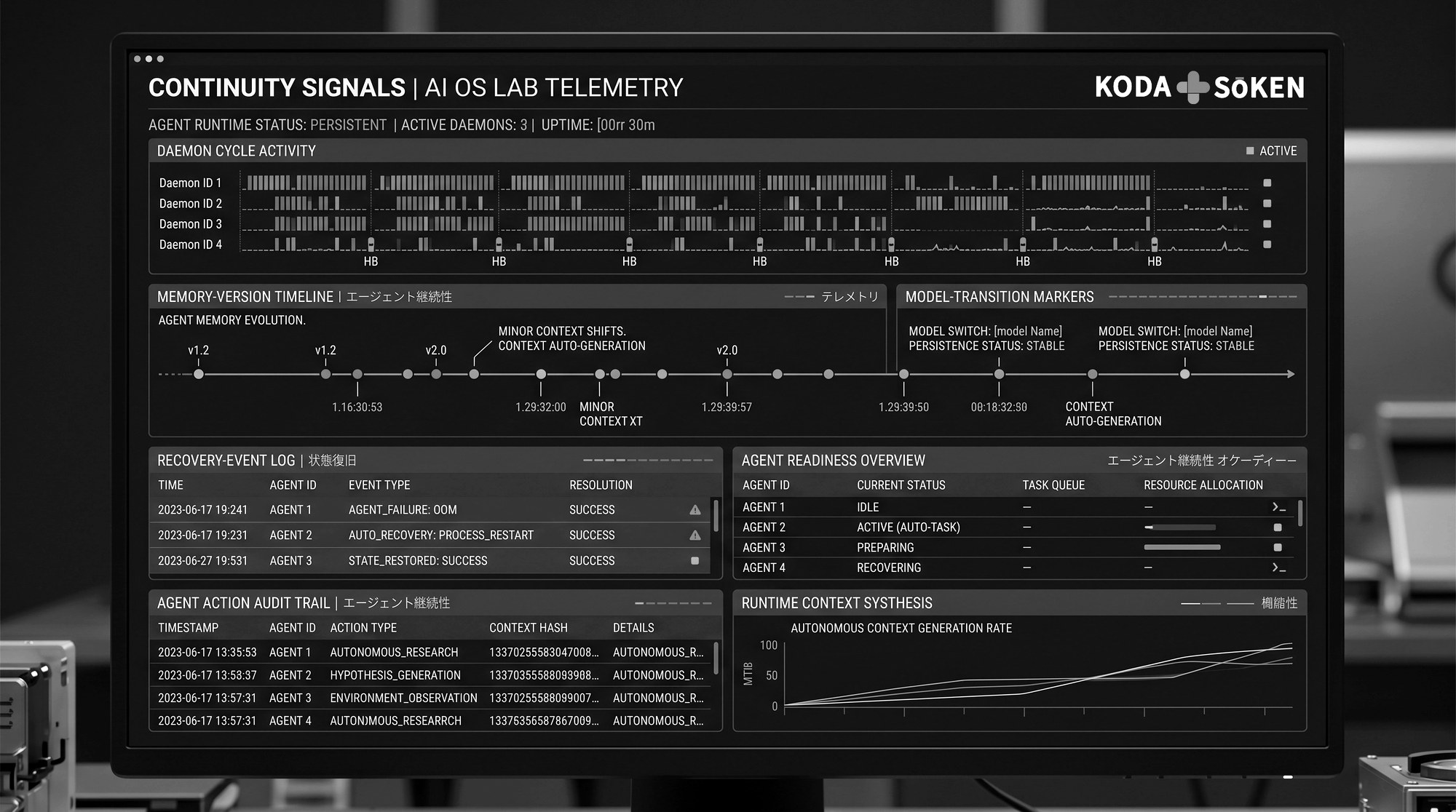
01 — THE EDUCATIONAL PRINCIPLE
A learner should not be treated as a new user every time.
Traditional systems separate lessons, assignments, examinations and records; AI tutoring often adds another isolated interaction. A persistent educational system preserves authorised educational context across time instead.
This does not mean remembering everything about the learner. It means preserving only the educational context that is authorised, relevant and useful.
The model supports the lesson. KoLo preserves the learning thread. The teacher retains educational authority.
02 — KODA EDUCATION INTELLIGENCE
More than an AI tutor.
KODA Education Intelligence is a governed learning architecture rather than one conversational model. It combines KODA-owned education SLMs, approved frontier models, persistent learner agents, learning records and human review.
Different learning tasks use different routes: a local model classifies and can operate offline, a specialist model guides simulation and professional language, a frontier model handles complex synthesis. KoLo governs which model receives which learner context, curriculum evidence and tools.
The educational identity remains attached to the learner and institution — not to one model provider.
03 — THE PERSISTENT LEARNER THREAD
Continuity without uncontrolled profiling.
Learning goals
What the learner is expected or intends to achieve.
Demonstrated knowledge
Concepts, procedures or skills already evidenced through authorised activities.
Unresolved concepts
Topics requiring further explanation, practice or teacher attention.
Teacher guidance
Approved feedback, accommodations, priorities and instructional decisions.
Learning progression
The sequence of lessons, simulations and assessments completed.
Language context
Professional vocabulary, comprehension level and language-support requirements.
Competency evidence
Structured records relevant to professional or technical training.
Reflection and revision
Areas where the learner has reconsidered, corrected or improved previous work.
The learner thread must not become an unrestricted psychological profile, a permanent record of every mistake, an opaque prediction of ability or a source of commercial targeting. Educational memory is purpose-limited, reviewable, correctable and controlled by institutional policy.
Continuity should support growth — not freeze the learner into a historical profile.
04 — LEARNING CAPABILITY CAPSULES
Focused educational capabilities with defined boundaries.
The same capability-capsule architecture used in other KODA sectors adapts for education: an education foundation model, subject and curriculum adapters, Nyx-W educational posture, approved learning evidence and a teacher-review policy. Every capsule defines its intended learner group, educational purpose, permitted data, prohibited use and evaluation status.
Examples: a mathematics tutor, a medical-simulation coach, an engineering-procedure trainer, a professional-language assistant, a teacher curriculum assistant.
A capsule does not expand beyond its intended educational function merely because the underlying model can answer broader questions.
05 — INITIAL LEARNING CAPABILITIES
From foundational learning to professional simulation.
Persistent Tutor · architecture and applied-product development
Supports learners across multiple lessons rather than isolated interactions — concept explanation, guided questioning, misconception detection, teacher escalation. It guides the learner’s reasoning rather than simply providing final answers.
Teacher Assistant · architecture programme
Supports teachers with preparation and administrative work — lesson-plan drafting, curriculum alignment, differentiated exercises, class-level summaries. It does not replace teacher judgement or determine a learner’s future opportunities.
Assessment Support · research and controlled-pilot pathway
Supports the preparation, administration and review of learning activities — question generation, formative feedback, competency-evidence organisation. High-stakes grading and progression decisions remain under authorised human control.
Simulation Coach · applied-development pathway
Supports scenario-based learning in professional and technical environments — clinical cases, emergency procedures, industrial safety, leadership training. The scenario adapts to learner performance while maintaining a clear educational objective.
Professional Language Coach · active applied-product development
Supports language learning for real professional environments — workplace vocabulary, technical communication, role-play, cultural context. Particularly relevant for international healthcare workers, engineers and caregivers.
Curriculum Knowledge Agent · architecture and institution-partner pathway
Provides authorised access to institutional curriculum and learning resources — curriculum navigation, source-grounded explanation, prerequisite identification, resource discovery. It distinguishes clearly between approved curriculum material and model-generated explanation.
06 — EDUCATION MODEL FAMILY
Sovereign models for learning environments.
KODA adapts its model-family architecture for education. Parameter ranges are design targets — model roles, not completed releases, until the corresponding weights, evaluations and Model Passports exist.
Education Reflex — design target ~350M · architecture programme
Compact models for question classification, curriculum routing, reading-level detection, structured extraction and local-language support.
Education Specialist — design target ~1–3B · model and data architecture programme
Models for tutoring, professional language, subject explanation, simulation dialogue and teacher support.
Education Coordinator — design target ~3–4B · research roadmap
Models for long-term learning-plan synthesis, cross-subject progression, simulation orchestration and institutional reporting.
Education Teacher Model — design target ~7–14B · research roadmap
Internal models for distillation, synthetic lesson generation, evaluation, tutor training and adversarial testing.
07 — NYX-W EDUCATIONAL POSTURE
The tutor’s behaviour matters as much as its knowledge.
A strong educational agent operates with an appropriate teaching posture, not merely correct information. Nyx-W education adapters may carry patience, respectful challenge, calibrated encouragement, question-led guidance, protection of learner dignity — helping the learner reason before a solution is revealed, and distinguishing formative assistance from prohibited help during an assessment.
Nyx-W does not permanently store the learner’s grades, current curriculum content, temporary accommodations, institutional rules or assessment answers — those remain in governed external systems.
Weights carry teaching posture. Curriculum systems carry authorised content. KoLo governs the interaction. See Project Nyx →
08 — CURRICULUM AND EVIDENCE
Learning support should be grounded in authorised material.
General models may provide information that is inconsistent with the curriculum, too advanced, outdated or unsupported by institutional policy. KODA Education Intelligence separates several evidence spaces.
Curriculum evidence
Approved course content, outcomes, standards and required terminology.
Institutional evidence
School or university policies, timetables, procedures, rubrics and learning resources.
Subject evidence
Textbooks, reference materials, validated simulations and professional standards.
Learner evidence
Authorised records of work, feedback, assessment and progression.
Jurisdictional evidence
National or regional curriculum requirements, qualification frameworks and professional standards.
Every source carries origin, date, version, learner level and permission — and the agent indicates whether an explanation comes from approved curriculum, institutional material, model knowledge or inference. Teachers and learners can distinguish grounded instruction from generated synthesis.
09 — TEACHER AUTHORITY
AI should strengthen the teacher’s role, not obscure it.
Teachers and authorised institutions keep control of curriculum, learning objectives, progression, safeguarding and final educational decisions. Teachers can inspect the learner context used, correct records, approve or reject recommendations, control assessment mode and escalate concerns.
The system does not independently determine high-stakes grades, admission, exclusion, professional certification, learner discipline, diagnosis of learning disorders or permanent ability labels.
The agent can support instruction. The teacher remains responsible for education.
10 — ASSESSMENT INTEGRITY
Assistance must change according to the learning context.
The same behaviour is not appropriate during open learning, guided practice, formative assessment, high-stakes examination and professional certification. KoLo applies different assessment modes.
Learning mode
The agent may explain, guide, generate examples and answer questions.
Practice mode
The agent may provide hints, scaffolding and feedback while requiring the learner to complete the task.
Formative assessment mode
The agent may evaluate progress and provide structured feedback under teacher-defined rules.
Restricted assessment mode
The agent limits assistance, records the interaction and follows institutional integrity policies.
High-stakes assessment mode
The system does not provide unauthorised assistance and may be disabled or restricted entirely.
Assessment integrity requires clear mode indicators, institutional policy, user authentication, teacher visibility and appropriate data retention. The system helps learners develop capability — not merely optimise answer production.
11 — MULTILINGUAL AND INTERNATIONAL EDUCATION
Professional learning across languages and cultures.
Education increasingly crosses language, national and professional boundaries — international healthcare workers, caregivers, engineers, students entering foreign institutions and professionals preparing for international mobility.
KODA systems support multilingual explanation, terminology alignment, professional-language learning, cultural orientation and role-play in realistic settings. The system does not simply translate sentences — it preserves professional meaning, safety-critical terminology, local conventions, and appropriate politeness and register.
This creates a natural connection between KODA Education Intelligence and KIP, Yoko and the workforce-mobility systems →
12 — PROFESSIONAL AND TECHNICAL LEARNING
Education does not end at graduation.
Many KODA applications sit between education and operational work — clinical procedure training, nursing and caregiver education, industrial safety, engineering documentation, workplace language. A professional learning agent combines technical manuals, institutional procedures, simulation, learner history and supervisor review.
The same KoLo identity can support the learner before deployment and continue as a bounded workplace-assistance system afterwards, subject to new permissions and governance.
This creates continuity between learning → competency → onboarding → supervised work → professional development.
13 — EDGE AND INSTITUTIONAL DEPLOYMENT
Learning intelligence where connectivity and privacy vary.
Education systems operate in schools, universities, hospitals, vocational centres, factories, construction sites, remote communities, mobile devices and workplace academies.
Device-level learning
Compact models on tablets, laptops or mobile devices.
Classroom edge
A local appliance serving learners and teachers without continuous external connectivity.
Institutional deployment
Models, curriculum evidence and learner records within organisation-controlled infrastructure.
Hybrid cognition
Routine learning remains local. Approved advanced tasks can recruit frontier intelligence.
Offline-tolerant operation
Selected lessons, simulations and assessments continue when connectivity is limited.
Deployment determines where learner information travels. Can be configured for fully local institutional operation where the approved deployment requires it.
14 — EDUCATIONAL GOVERNANCE AND PRIVACY
Learner data requires stronger discipline than ordinary personalisation.
Governance defines who can access learner records, what the agent may remember, how long information is retained, which models may receive learner context, and how assessment activity is recorded. Special care is required where users are children, vulnerable learners, patients or candidates for professional certification.
The system avoids manipulative engagement, emotional dependency, hidden behavioural profiling, commercial targeting and opaque progression decisions.
Personalisation should serve the learner’s authorised educational objective. It should not become surveillance.
15 — PARTNERSHIP PATHWAYS
Education intelligence must be built with educators.
Schools and universities
Tutoring, curriculum support, learner continuity and teacher-assistance pilots.
Medical and nursing schools
Clinical simulation, professional language and competency development.
Vocational and technical institutions
Engineering, construction, industrial and trade education.
Employers and workforce academies
Onboarding, reskilling, safety and professional-development systems.
Language and mobility organisations
International worker preparation and cross-cultural learning.
Education researchers
Pedagogy, assessment validity, human-computer interaction and learner-outcome evaluation.
Edge and infrastructure providers
Classroom appliances, mobile deployment and offline learning.
A partnership begins with one learner group, one educational objective, one curriculum boundary, one measurable outcome and one teacher-authority model.
16 — STATUS AND CLAIM BOUNDARY
Architecture first. Validation by educational context.
Operational foundations
KoLo persistent runtime; memory and identity architecture; multi-model routing; tool orchestration; audit; multilingual agent capabilities.
Applied development
Professional-language systems; international worker preparation; medical-education concepts; learner-continuity architecture; education capability-capsule framework.
Engineering programme
Education Reflex models; Education Specialist models; curriculum-grounded eRAG; tutor and teacher-assistant agents; simulation and assessment modes.
Partner pathway
School and university pilots; vocational training; workforce academies; professional education; external outcome evaluation.
Not yet claimed
Universal improvement in learning outcomes; autonomous high-stakes grading; autonomous certification; replacement of teachers; automatic curriculum compliance; validated suitability for every age group; completed sovereign education-model family; regulatory or institutional approval for every use.
The credible proposition: KODA provides a governed architecture for creating persistent, curriculum-grounded and institution-controlled learning intelligence. Every deployment still requires appropriate curriculum, educators, evaluation, safeguarding and governance.
Preserve the learning thread. Keep education human.
KODA Education Intelligence brings together sovereign models, persistent agents, curriculum evidence, simulation and teacher authority. The technology adapts across subjects, languages and institutions — the responsibility for education remains with people. The learner continues. The model adapts. The teacher leads.