

APPLIED SYSTEMS · PERSISTENT AGENTS · SOVEREIGN INTELLIGENCE
One operating architecture.
Many systems built for real work.
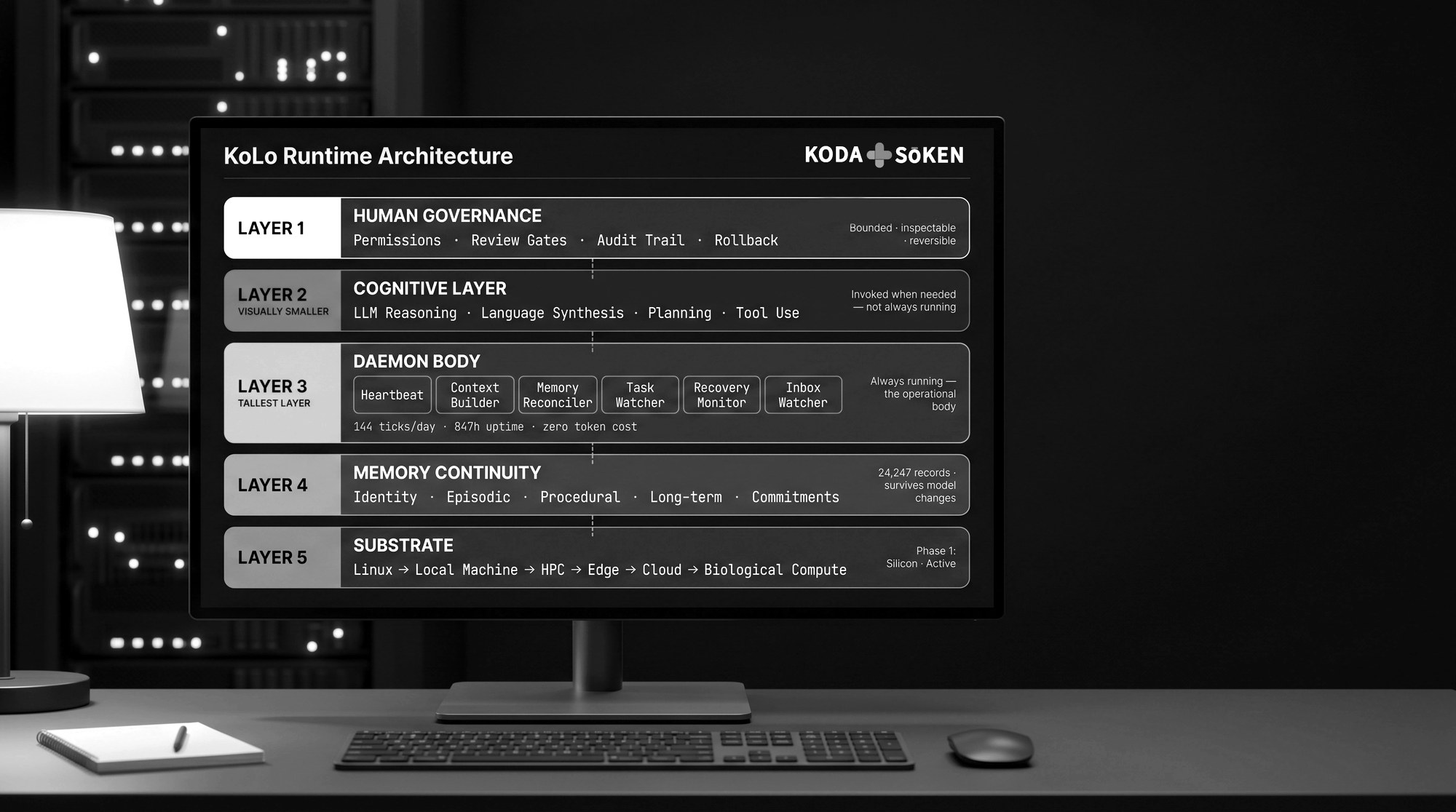
KODA applications share one foundation — persistent KoLo agents, sovereign models, governed memory, Guardian verification and human authority. Each adapts it to a specific sector, institution and workflow.
One identity architecture. Different operational systems.
01 — THE APPLIED-SYSTEMS PRINCIPLE
Products should share infrastructure without sharing everything.
The common foundation provides persistent identity, memory, model routing, evidence retrieval, agent collaboration, audit and human approval. Each applied system adds its own users, terminology, workflows, evidence, permissions and deployment profile.
This creates reuse where the authority and evidence boundary allows it, and separation everywhere else. A worker-support agent does not automatically access an employer’s private systems; a learning agent does not expose the learner’s history to a recruiter.
Shared architecture does not mean shared authority. The portfolio is organised into three levels: platforms organise the journey, applications solve defined problems, capabilities provide reusable intelligence.
03 — HEALTHCARE SYSTEMS
Clinical and operational intelligence under professional authority.
healthcare platform · Status: active architecture and product-development programme
The healthcare-intelligence platform built on KoLo — sovereign medical models, persistent clinical agents, controlled evidence, Guardian review, clinician approval. Potential uses: documentation, handover, medication-discrepancy review, professional education, hospital operations.
healthcare-operations application · Status: enterprise proposal and controlled-pilot pathway
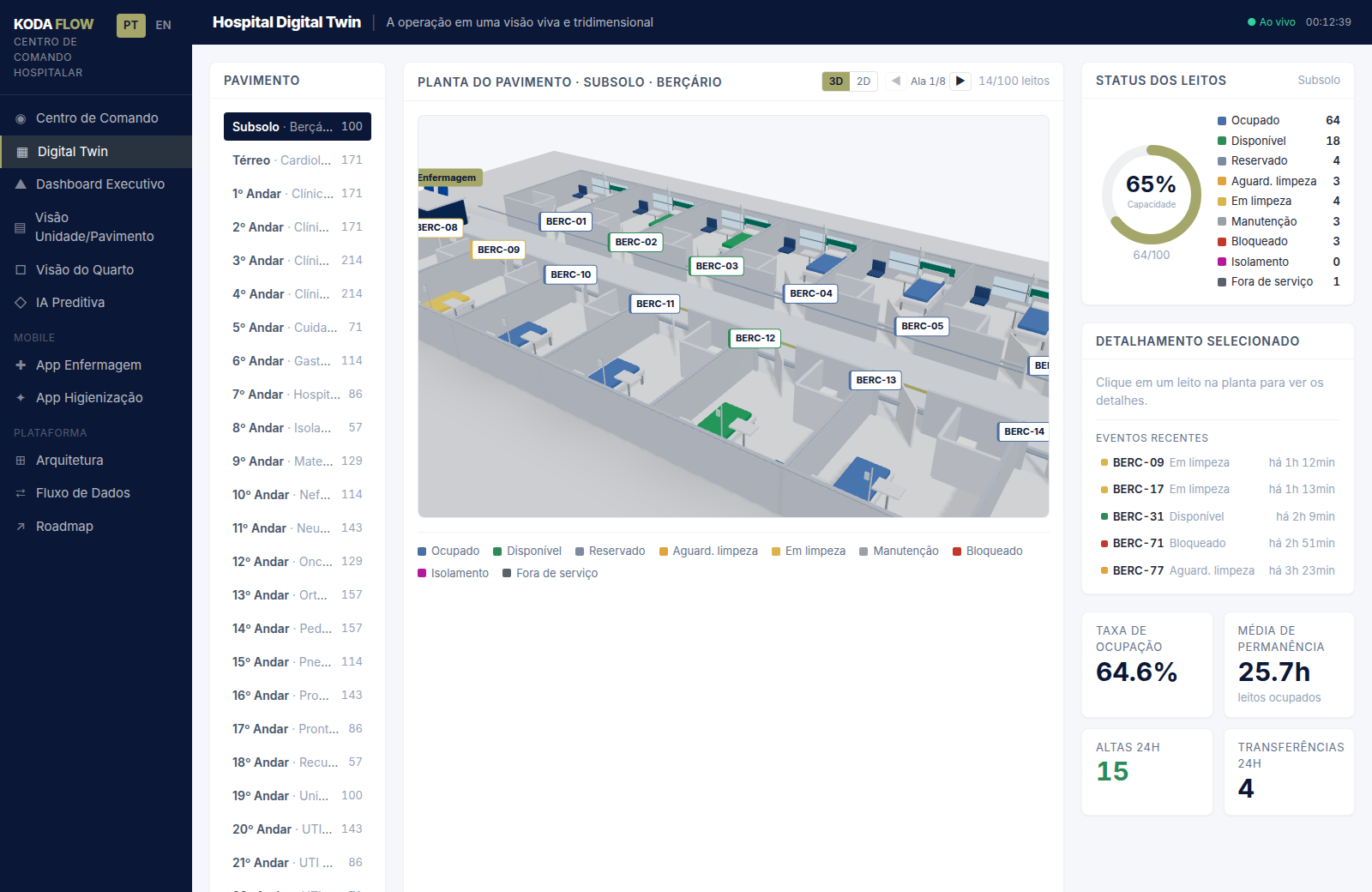
The hospital-operations application within the wider healthcare architecture — patient flow, bed coordination, admissions, discharge, executive visibility. One operational thread across departments without collapsing clinical and administrative permissions.
healthcare workflow application · Status: pre-production development
Multilingual administrative and communication workflows close to the point of care — reception assistance, form preparation, structured documentation, authorised translation. Clearly separated from autonomous clinical decision-making.
04 — WORKFORCE AND MOBILITY SYSTEMS
Continuity across preparation, movement and employment.
workforce and mobility platform · Status: platform and business-development programme
The broad workforce-mobility and placement architecture — worker profiles, verified skills, role matching, ethical recruitment, continuing support. The worker remains one person across the journey rather than becoming a new record at every stage.
mobility-support platform · Status: active product development
The worker-facing mobility guidance and international-support platform — journey planning, document preparation, arrival support, workplace guidance, escalation to qualified people. Yoko does not claim legal or immigration authority.
professional-learning application · Status: active applied development
Professional language, workplace communication and cultural preparation — role-specific vocabulary, realistic workplace scenarios, safety communication, progress continuity. Focused on language required for actual professional participation.
workplace-support application · Status: product concept and engineering pathway
A bounded worker-assistance application for continuing support after onboarding — workplace guidance, terminology, training access, escalation to human assistance. It must not become an invisible employer-surveillance system.
05 — KNOWLEDGE AND LEARNING SYSTEMS
Persistent intelligence for institutions and professionals.
institutional-intelligence platform · Status: platform architecture and applied-development programme
KODA’s persistent knowledge and intelligence environment for document-heavy, multi-agent and institutional work — research, project memory, governed retrieval, specialist-agent collaboration, provenance. A persistent intelligence workspace rather than a general chat interface.
language-learning architecture · Status: architecture programme
The broader persistent language-learning architecture from which specialised applications such as KipTalk are assembled — general progression, persistent learner context, adaptive practice, cultural context.
collaborative design application · Status: concept and applied-development pathway
A collaborative intelligence environment for structured concept development and multidisciplinary creation — requirements capture, research synthesis, design rationale, decision history. It preserves why a decision was made — not only the latest output.
06 — SPECIALIST AND EXPERIMENTAL SYSTEMS
Applications that require dedicated evidence and release boundaries.
Trading Intelligence
specialist research application · Status: research and controlled-development pathway
A research and decision-support environment for financial analysis — market information organisation, scenario construction, thesis tracking, risk review, source attribution. NOT positioned as guaranteed trading performance, autonomous financial authority, personalised regulated investment advice, or a substitute for licensed financial professionals.
Voice Intelligence
reusable capability · Status: integration pathway
Speech recognition, multilingual conversation, structured dictation, accessibility support, offline or edge speech — a shared capability mounted across several KODA systems, not a separate platform.
Vision Intelligence
reusable capability · Status: integration and evaluation pathway
Document understanding, industrial inspection, equipment identification, technical imagery, multimodal learning. Vision outputs are linked to source image, model version, confidence and intended use — vision capability does not automatically establish diagnosis, inspection acceptance or professional judgement.
07 — ONE SYSTEM CAN USE SEVERAL APPLICATIONS
Connected journeys without one unrestricted database.
A worker entering Japan for a healthcare role may move across several KODA systems — they do not automatically share information. KoLo enforces purpose limitation, consent, role-based access, minimum disclosure and audit.
1 — Cangoo
Organises verified skills and placement.
2 — KipTalk
Supports professional Japanese.
3 — Yoko
Guides mobility preparation and arrival.
4 — Aria
Supports workplace adaptation.
5 — KODA Workforce Academy
Provides continuing education.
6 — Medical Clerk Workstation
Supports the institutional workflow.
7 — KODA Kenkō
Supports authorised healthcare operations.
A continuous journey does not justify unlimited visibility.
08 — SHARED CAPABILITY LAYER
Build once, govern everywhere.
Identity and consent
User, institutional and agent identity; permissions; consent records; revocation.
Persistent memory
Authorised user context, institutional memory, unresolved work, decision lineage, recovery.
eRAG
Source-controlled retrieval, versioning, jurisdiction, provenance, access restrictions, supersession.
Model routing
Edge models, KODA sovereign models, frontier models, deterministic tools, human expertise.
Agent collaboration
Delegation, review, challenge, consolidation, escalation.
Speech and vision
Multilingual voice, document understanding, images, equipment and environmental inputs.
Guardian verification
Evidence review, contradiction checks, policy enforcement, uncertainty, prohibited actions, escalation.
Audit and recovery
Route history, model versions, tool calls, approvals, rollback, failure records.
A shared capability is still configured and evaluated separately for each product and intended use. Technical detail: Architecture → · KoLo Runtime → · Sovereign Models → · KoLo Agents → · measurable claims: Benchmarks →
09 — AGENT PASSPORTS · 10 — PRODUCT INTEROPERABILITY
Interoperate through contracts, not assumptions.
Every agent carries an Agent Passport — identity, role, owner, permitted memory, eligible models, approved tools, human-approval rules. A Yoko mobility agent and a KODA Kenkō clinical agent share KoLo runtime primitives, never evidence, authority or memory — the passport makes that inspectable.
KODA systems exchange information through explicit capability and data contracts — each specifying purpose, user consent, data fields, retention and responsible owner.
Cangoo → KipTalk
Share only the professional role and authorised language requirements needed to prepare the worker.
Yoko → Aria
Transfer unresolved onboarding tasks and approved workplace-support context after arrival.
KODA FLOW → Medical Clerk Workstation
Share authorised operational status without exposing unnecessary clinical information.
KIP → Open Design
Transfer approved research and project evidence while preserving sources and access restrictions.
This prevents convenience-driven integration from silently expanding authority.
11 — DEPLOYMENT PATTERNS
Applications should fit the institution — not force one infrastructure model.
Device level
Compact models and selected memory on mobile, tablet or workstation devices.
Institutional edge
A local appliance provides models, evidence and agent services inside the organisation.
Private infrastructure
The institution controls the runtime, models, memory, tools and audit environment.
Dedicated cloud
A controlled cloud environment supports distributed users and institutional integration.
Hybrid cognition
Local models perform routine and sensitive work; approved frontier models are recruited for specific tasks using the minimum authorised context.
Multi-institutional federation
Separate organisations collaborate through controlled contracts without merging their complete datasets.
The pattern is selected according to privacy, jurisdiction, latency, resilience and intended use.
12 — PRODUCT STATUS · 13 — PORTFOLIO DISCIPLINE
Every system must show its actual stage.
Concept
The problem, users and intended architecture have been defined.
Architecture
The system design, boundaries and primary workflows are documented.
Engineering scaffold
Core software, interfaces or workflows exist, but the complete system is not yet validated.
Active development
The product is being implemented and tested.
Internal pilot
The system is operating in a controlled KODA environment.
Partner pilot
The product is being evaluated with an external institution under defined conditions.
Pre-production
The system is preparing for limited operational release.
Production release
The defined version has passed the required technical, operational and sector-specific release gates.
Externally validated
A relevant independent institution has completed the stated evaluation.
“Live”, “deployed”, “production-ready” and “validated” are never used without identifying the product version, intended use, institution, evidence and date. KODA does not launch a new brand for every feature — a new name requires a distinct user, journey, operating boundary and product scope; otherwise the function remains a capability or module.
14 — BUILD WITH KODA
Start from the operating problem, not the product catalogue.
1 — Operational problem
What work needs to become safer, faster, clearer or more continuous?
2 — User and authority
Who uses the system? Who remains responsible?
3 — Evidence
Which information is permitted, current and authoritative?
4 — Workflow
Which people, systems and approvals are involved?
5 — Cognitive route
Which tasks require deterministic software, edge models, sovereign specialists, frontier models or human expertise?
6 — Operating boundary
What may the system do? What must it never do?
7 — Pilot
How will usefulness, risk and continuity be measured?
The result may be an existing KODA application, a configured platform, a new Capability Capsule, an institution-specific system or a new product partnership.
15 — CLAIM BOUNDARY
A portfolio map is not a statement that every product is commercially released.
The portfolio does not currently establish that every listed product is production-ready; that every application has completed external validation; that all systems are available in every country; that one deployment configuration fits every institution; that capabilities can be transferred between sectors without evaluation; that shared architecture permits unrestricted data sharing; or that a named application has regulatory approval merely because the architecture exists.
The credible proposition: KODA has one reusable architecture for creating persistent, sovereign and governed applied-intelligence systems. Each product must still be developed, evaluated and released for its specific users, workflow and intended use.
Research becomes valuable when it changes real work.
KODA applies its architecture through systems for healthcare, mobility, workforce, education, knowledge and industrial operations. Each system is distinct; the foundation remains shared. One architecture. Many operating environments. Clear authority in every application.