

HEALTHCARE AND LIFE SCIENCES · KODA KENKŌ · TOKYO
Clinical intelligence
that keeps the patient thread.
Healthcare does not begin again with every appointment, shift, department or system. KODA Kenkō combines sovereign medical models, capability agents, controlled clinical evidence and human authority within the persistent KoLo runtime.
Built from Japanese clinical reality. Designed for governed healthcare globally.
01 — THE CLINICAL PRINCIPLE
A patient should never become a cold start.
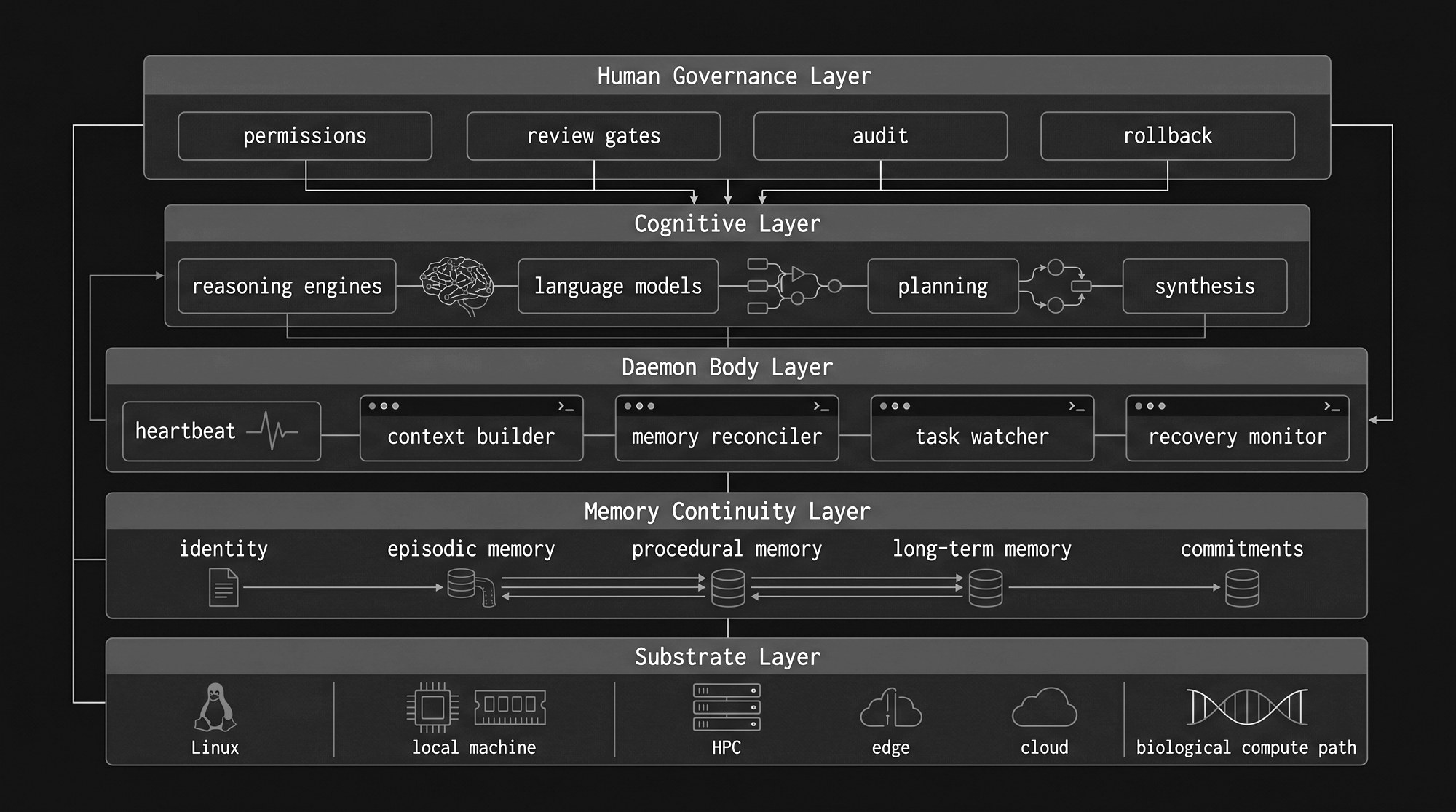
Clinical work extends across consultations, shifts, departments and institutions — isolated model sessions lose that context. A governed healthcare-intelligence system preserves authorised patient context across approved workflows; KoLo can maintain approved patient context, unresolved actions, medication history, professional handovers, complete audit.
Continuity is not unrestricted memory. It is the controlled preservation of relevant context across authorised workflows.
The model assists with the task. KoLo preserves the thread. The healthcare professional remains accountable.
02 — KODA KENKŌ
A governed clinical-intelligence architecture.
KODA Kenkō is not one medical chatbot. It is a healthcare architecture that combines Kenkō-W sovereign medical models, approved frontier models, persistent KoLo agents, independent Guardian verification, clinician-approval gates.
Different tasks use different cognitive routes: routine extraction stays local, documentation uses a sovereign medical specialist model, complex non-diagnostic synthesis may recruit an approved frontier model. Clinically consequential results may require both Guardian review and explicit professional approval.
The workflow remains one governed and attributable clinical operation. The applied product lives at koda-kenko.com ↗
03 — CLINICAL CAPABILITY CAPSULES
Bounded capabilities, not unrestricted assistants.
A Clinical Capability Capsule is a versioned, governed assembly for one healthcare function: Kenkō-W foundation model, speciality and jurisdiction adapters, approved clinical eRAG, Guardian policy, human approval. Every capsule specifies intended use, prohibited use, permitted data, escalation conditions, responsible clinical owner.
A capsule does not receive authority beyond its defined purpose merely because its model is technically capable of more.
Capability is composed. Authority is constrained. Accountability remains human.
Explore Clinical Capability Capsules →04 — INITIAL CLINICAL CAPABILITIES
Focused support across the care pathway.
Kenkō Scribe Edge · engineering scaffold and development pathway
Supports structured clinical documentation from authorised input — note drafting, structured extraction, terminology normalisation, summary preparation. The output remains a draft until reviewed by an authorised professional.
Kenkō Handover · engineering scaffold
Supports continuity between clinical, nursing and caregiving teams — shift summaries, outstanding actions, changes since the previous handover, multilingual handover support. It does not replace professional judgement at the point of handover.
Kenkō Patient Bridge · engineering scaffold and product-development pathway
Supports communication between professionals, patients, families and international workers — multilingual explanation, discharge-instruction preparation, comprehension checks, voice interaction. It explains only information authorised by the healthcare team.
Kenkō Medication Guardian · engineering scaffold requiring formal clinical evaluation
Supports the identification of discrepancies and risk signals for pharmacist or clinician review — medication-list comparison, duplicate detection, allergy-context checking, possible interaction signals. It does not independently prescribe, discontinue or alter treatment.
Kenkō Geriatric Care Assistant · engineering scaffold and partner-development pathway
Supports structured documentation and communication across older-person care — care observations, change detection, caregiver handover, multilingual care support.
Kenkō Wound Documentation Assistant · engineering scaffold
Supports consistent longitudinal wound documentation — structured observation, comparison with previous records, review preparation. It does not independently diagnose or prescribe treatment.
05 — KENKŌ-W SOVEREIGN MEDICAL MODELS
Medical intelligence that can remain close to the institution.
KODA is developing a sovereign medical model family for healthcare environments requiring local control, privacy, low latency, predictable cost or offline operation. Parameter ranges are architectural targets — not completed trained models unless the corresponding weights and evaluations exist.
Kenkō-W Reflex — design range ~350M · architecture and training scaffold
Compact models for routing, extraction, structured output, safety classification and tool selection.
Kenkō-W Specialist — design range ~1–3B · active model programme
Medical models for documentation, patient communication, nursing and caregiver workflows, and multilingual clinical operations.
Kenkō-W Coordinator — design range ~3–4B · research roadmap
Institutional models for long-document synthesis, cross-speciality coordination, clinical timelines and multi-agent workflow consolidation.
Kenkō-W Teacher — design range ~7–14B · research roadmap
Internal models for distillation, synthetic-case generation, capability evaluation and Guardian development.
06 — CLINICAL EVIDENCE AND MEMORY
Current truth must remain attributable.
Medical weights should not become the permanent store for changing clinical truth. KoLo separates several evidence spaces.
Canonical medical knowledge
Approved medical references, terminology and validated educational material.
Jurisdictional knowledge
Country-specific guidance, terminology, policies and regulatory context.
Institutional knowledge
Hospital procedures, formularies, escalation paths, templates and approved workflows.
Patient-episode knowledge
Authorised information on the current care episode — observations, medications, allergies, investigations, outstanding actions.
Current clinical truth belongs in governed evidence. Professional posture may be carried in Nyx-W.
07 — THE CLINICAL GUARDIAN
Generation and verification are separate duties.
A generating model should not be solely responsible for validating its own output. The Clinical Guardian — kept separate from the generating model where technically possible — independently examines whether claims are supported by the supplied evidence; whether important information is missing; whether records contradict one another; whether escalation is required; whether human approval is mandatory.
The Guardian may approve the result for professional review, request correction, require additional information, block an unsafe route, or escalate to an authorised person.
The Guardian is one control within the wider clinical-safety architecture. It does not automatically make an unvalidated system safe or clinically approved.
08 — HEALTHCARE OPERATIONS
Clinical continuity also depends on operational continuity.
KODA FLOW → · enterprise proposal and controlled-pilot pathway
Hospital operations intelligence — patient flow, bed coordination, admissions and discharge, transfers, cleaning workflows, bottleneck identification, executive visibility.
Medical Clerk Workstation · pre-production development
Multilingual workflow support — reception, clerical documentation, communication, forms, scheduling, international-patient support.
Medical Education · applied-product development
Persistent systems for medical and nursing education, procedure training, simulated cases, professional language, competency preparation and continuing education.
Clinical and operational systems may share the same KoLo infrastructure while retaining separate permissions, evidence and accountability.
09 — EDGE, INSTITUTIONAL AND HYBRID DEPLOYMENT
Intelligence deployed according to clinical policy.
Clinical edge
Compact models and evidence services operate on a workstation, tablet or clinical appliance.
Hospital infrastructure
Models, memory, evidence and audit remain within institution-controlled servers.
Private cloud
Dedicated cloud environments provide controlled institutional deployment.
Hybrid cognition
Routine or sensitive work remains local. Approved complex tasks may recruit external frontier intelligence using only the minimum authorised context.
Offline-tolerant operation
Selected workflows can continue during external connectivity disruption where the deployment has been designed and validated for that purpose.
The deployment architecture determines where information travels, which models can be used, what remains local and what fallback routes exist. Can be deployed fully within the institution where policy and the approved configuration require it.
10 — HUMAN AUTHORITY AND GOVERNANCE
Healthcare professionals remain responsible for care.
KoLo governance controls user identity, access permissions, model eligibility, clinician approval and audit. Different capabilities require different levels of authority — they do not share the same risk or regulatory status.
Administrative assistance
May support clerical and operational work within approved procedures.
Documentation assistance
May prepare drafts for professional review.
Patient communication
May explain authorised information within defined boundaries.
Professional education
May support training without representing itself as direct patient care.
Clinical decision support
Requires stronger evidence, validation, safety controls and professional oversight.
Regulated medical functions
May require formal medical-device classification, quality systems, clinical evaluation and regulatory approval depending on intended use and jurisdiction.
Intended use defines the boundary. Human authority defines the final decision.
11 — FROM JAPAN TO GLOBAL HEALTHCARE
Japan is the proving ground, not the boundary.
KODA Kenkō is shaped by challenges visible in Japanese healthcare — administrative burden, ageing populations, workforce shortages, multilingual communication, and the need for local, auditable systems.
The underlying architecture is not limited to Japan. The same approach can be adapted for the United Kingdom, Canada, Australia, Germany, other healthcare systems and care environments — with appropriate work on language, terminology, clinical workflow, regulation and evaluation in each.
The credible proposition is not one global model used everywhere. It is one governed architecture, adapted to the reality of each healthcare system.
12 — PARTNERSHIP PATHWAYS
Clinical intelligence must be developed with healthcare institutions.
Hospitals and clinics
Clinical, administrative and operational workflow pilots.
Nursing and care organisations
Handover, documentation, multilingual care and workforce support.
Medical schools and training institutions
Simulation, professional education and competency evaluation.
Pharmacy and medication specialists
Medication-reconciliation and Guardian evaluation.
Healthcare IT providers
System integration, FHIR-compatible workflows, security and deployment.
Universities and research organisations
Benchmark development, independent evaluation and replication.
Edge and infrastructure providers
Local inference, clinical appliances and controlled institutional deployment.
A partnership begins with one defined workflow, one intended use and one measurable outcome.
13 — STATUS AND CLAIM BOUNDARY
What is built, what is scaffolded and what remains to be validated.
Operational internally
KoLo runtime; persistent memory; multi-model routing; agent orchestration; audit architecture; internal Guardian patterns.
Engineering scaffold
Clinical Capability Capsules; healthcare API and control plane; model and adapter registries; evidence-service architecture; clinical edge deployment definitions; initial clinical-agent workflows.
Active development
KODA Kenkō applications; Medical Clerk Workstation; healthcare communication systems; Kenkō-W model programme.
Controlled-pilot pathway
KODA FLOW; institution-specific clinical and operational workflows.
External clinical validation
Not claimed unless an independent healthcare institution has completed the relevant evaluation.
Production medical-device status
Not claimed unless the specific function, version and intended use have completed the required regulatory and quality processes.
The architecture does not currently establish autonomous diagnosis; autonomous prescribing; autonomous treatment selection; clinical safety for every use; regulatory approval; automatic compliance; error-free medical reasoning. Benchmark claims live in the canonical registry →
The present proposition: a governed architecture for developing, evaluating and deploying healthcare-intelligence capabilities under professional authority.
Preserve the patient thread. Keep clinical authority human.
KODA Kenkō brings together sovereign medical models, persistent agents, controlled evidence, operational tools and professional oversight. Local where policy requires it. Frontier where capability helps. Governed throughout by KoLo.