

WORKFORCE AND GLOBAL MOBILITY · PERSISTENT SUPPORT · KOLO
The country changes.
The worker continues.
International mobility is not one application, one flight or one contract — it is a long journey across languages, qualifications, institutions and employers. KODA combines persistent KoLo agents, sovereign models, approved mobility information, multilingual learning and human support within one governed system.
One authorised worker thread — from preparation to professional life.
01 — THE MOBILITY PRINCIPLE
A worker is not a transaction.
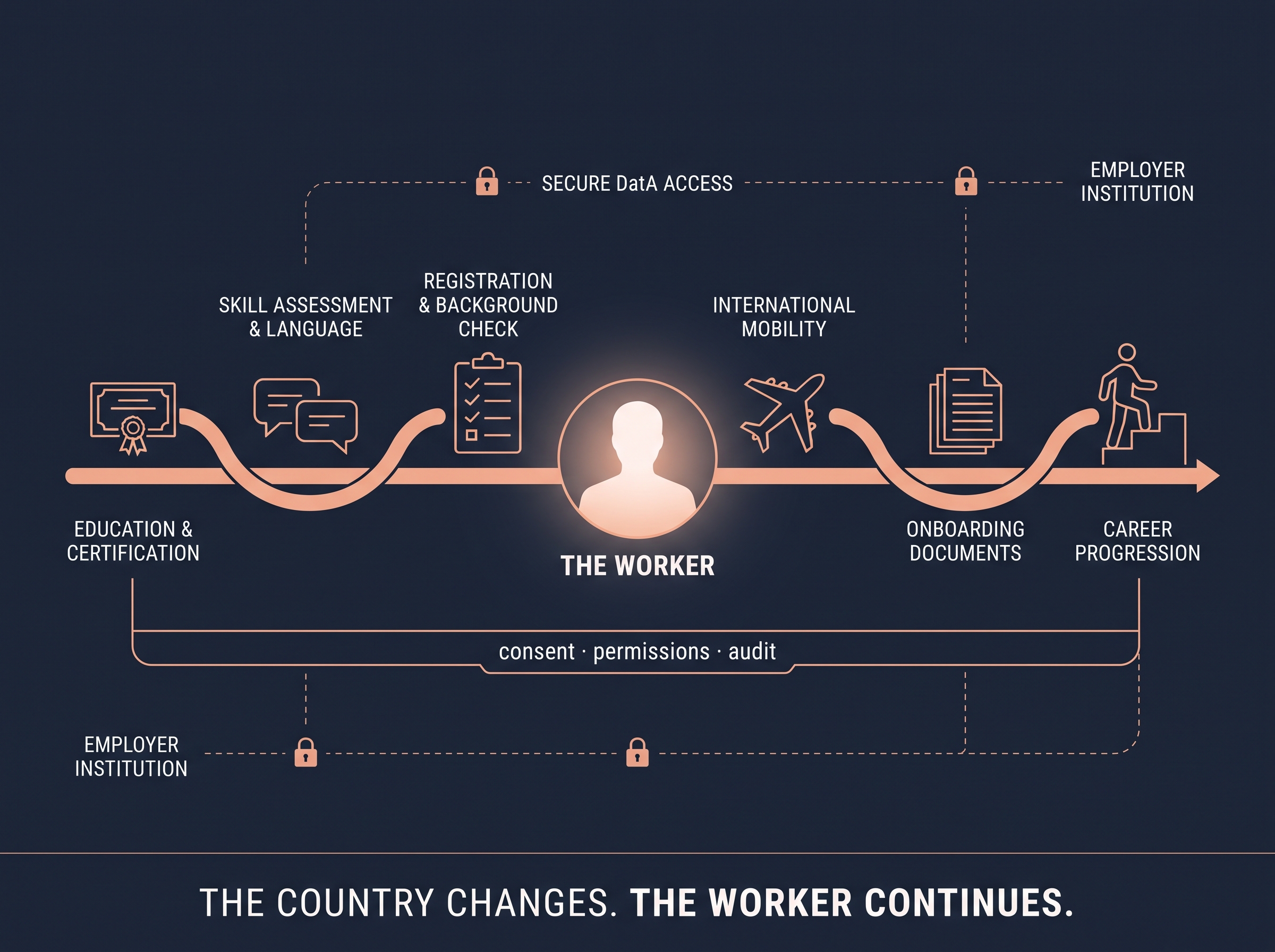
Traditional international recruitment divides the journey into disconnected stages; each organisation holds part of the story, and the worker repeats the same information. A persistent mobility system preserves the authorised thread across the journey — qualifications, verified skills, language progress, documentation status and unresolved actions.
This does not mean every institution sees everything. KoLo controls which information may be shared, with whom, for what purpose and for how long.
The platform supports the journey. The worker remains the person at its centre.
02 — A PERSISTENT MOBILITY ARCHITECTURE
More than a recruitment platform.
A KODA mobility system combines persistent worker agents, employer and recruiter agents, credential-verification services, sovereign mobility models, official mobility information, human advisers, and audit and consent controls.
A local model classifies documents and guides routine onboarding; a specialist model supports professional language and the task plan; a frontier model supports complex comparison and multilingual synthesis. A human remains necessary where legal interpretation, immigration decisions, professional licensing or safeguarding concerns are involved.
KoLo preserves one governed journey while different agents and institutions contribute.
03 — THE WORKER CONTINUITY THREAD
Support that follows the authorised journey.
Identity and consent
Verified identity, preferred language, consent status, authorised representatives, data-sharing permissions, revocation history.
Skills and qualifications
Education, professional credentials, technical skills, verified experience, competency records, recognition status.
Language and communication
Language level, professional terminology, learning objectives, completed preparation, workplace communication needs.
Mobility preparation
Destination, application pathway, required documents, completed tasks, deadlines, unresolved actions.
Employment context
Role, employer requirements, contract information, workplace policies, approved onboarding material.
Professional development
Completed training, competency progression, certifications, future learning goals, career-mobility options.
Support and escalation
Unresolved questions, safeguarding concerns, adviser referrals, complaints, authorised follow-up.
The continuity thread remains purpose-limited, reviewable by the worker, correctable and permission-controlled. Continuity should reduce repetition and vulnerability — not create permanent surveillance.
04 — MOBILITY CAPABILITY CAPSULES
Focused assistance for defined stages.
A Mobility Capability Capsule is a bounded assembly designed for one part of the worker journey: a KODA foundation model, mobility, task and destination-country adapters, Nyx-W professional posture, approved evidence profile, tool permissions and a human-escalation policy. Every capsule defines intended use, supported users, authorised information, prohibited actions, human-review conditions and a responsible owner.
Examples: skills-recognition assistant, document-preparation assistant, professional-language coach, arrival and onboarding assistant, workplace communication assistant.
A capsule does not provide legal determinations merely because the underlying model can generate legal-sounding language.
05 — SKILLS AND QUALIFICATIONS
Make professional capability visible.
International workers often possess valuable experience that is difficult to compare across countries and qualification systems. KODA mobility systems support structured skills profiles, qualification extraction, competency mapping, missing-document identification and preparation for formal recognition.
The system distinguishes between worker-stated experience; document-supported experience; independently verified qualification; institutionally recognised credential; inferred skill; formally assessed competency — these are not equivalent. A model may organise the evidence; only authorised institutions or qualified assessors can grant formal recognition.
AI can make capability understandable. It cannot invent recognition that has not been granted.
06 — LANGUAGE AND CULTURAL PREPARATION
Language for the real workplace.
General language learning is not sufficient. Workers need technical vocabulary, safety instructions, professional documentation, politeness and register — how to ask for clarification and how to report a concern.
KODA systems such as KIP support:
Professional vocabulary
Role-specific language for healthcare, construction, engineering, hospitality, logistics and other sectors.
Scenario practice
Realistic conversations involving supervisors, colleagues, clients, patients, inspectors and public authorities.
Safety communication
Understanding and communicating hazards, instructions, refusal of unsafe work, emergencies, incidents and escalation.
Cultural orientation
Explaining workplace expectations without stereotyping individuals or presenting one culture as superior.
Progress continuity
Preserving authorised learning history across preparation, arrival and employment.
The objective is not merely to help the worker pass a language test. It is to support safe, confident and professional participation in the destination workplace. Learning architecture lives on Education & Professional Learning →
07 — DOCUMENT AND PROCESS SUPPORT
Reduce complexity without pretending to replace professional advice.
Mobility requires coordination across identity documents, education records, employment contracts, translations and destination-country requirements. KODA systems support checklist creation, document classification, structured extraction, deadline tracking and workflow status — always distinguishing between an official requirement, general information, model-generated explanation and an immigration-authority decision.
KODA does not claim that an agent can guarantee a visa; approve immigration status; interpret every legal exception; replace a licensed immigration professional; determine eligibility conclusively. Where legal or immigration judgement is required, the system refers the worker to an authorised professional.
The agent can organise the process. The competent authority decides the status.
08 — RECRUITMENT AND MATCHING
Better matching requires more than keyword comparison.
A responsible mobility platform considers verified skills, language, role requirements, working conditions, and legal and ethical recruitment constraints. KODA systems support role-to-skill matching, qualification-gap analysis, candidate-preparation plans and interview preparation.
The system makes no hidden or irreversible decisions about a worker’s opportunity — workers and employers can see which information was considered, which criteria influenced the match and where human judgement was applied. Matching does not use protected information unless legally justified and explicitly governed.
A recommendation should open a path — not silently close one.
09 — ETHICAL RECRUITMENT
Mobility must not depend on worker vulnerability.
Technology can improve recruitment efficiency — it can also amplify unfair practices if governance is weak. A KODA mobility system supports transparent fees; clear employment conditions; worker consent; understandable contracts; clear complaint routes.
The system records what information was presented, in which language, which version of the contract was accepted, which fees were disclosed and whether an adviser reviewed the case.
This does not eliminate misconduct. It makes the process more inspectable and harder to rewrite after the event.
10 — ARRIVAL AND ONBOARDING
The journey continues after placement.
Many mobility systems treat arrival as the end of the process. For the worker, it is often the beginning of the most difficult stage.
Arrival preparation
Travel information, required documents, first-day instructions, emergency contacts, accommodation information.
Employer onboarding
Workplace rules, schedules, reporting lines, safety procedures, payroll information, benefits, required training.
Local orientation
Transport, healthcare access, banking, communication, public services, local procedures.
Professional adaptation
Terminology, documentation, workplace etiquette, role-specific expectations, supervisor communication.
Follow-up
Unresolved onboarding tasks, worker questions, employer feedback, support referrals, training progress.
The worker’s persistent agent preserves the authorised context across these stages without exposing private information unnecessarily to the employer.
11 — WORKPLACE SUPPORT
Support should remain available after the first day.
A bounded workplace-support agent may explain approved workplace information, translate professional terminology, prepare a factual incident summary and escalate safeguarding concerns. It does not secretly report private conversations to the employer; make legal conclusions; advise unsafe resistance; impersonate a lawyer or union representative; promise an outcome; manipulate the worker into remaining in an unsafe situation.
The worker-facing agent and the employer-facing system have separate permissions and memory boundaries.
Support for the employer must not become surveillance of the worker.
12 — EMPLOYER AND INSTITUTIONAL SYSTEMS
Better worker support also improves institutional performance.
Employers use KODA systems for compliant onboarding, multilingual training, document workflow, competency tracking and retention support. The employer system operates under defined authority: it does not receive unrestricted access to private worker conversations, confidential support requests, immigration-advice discussions, or health information without appropriate basis.
Institutional dashboards focus on workflow status, training completion and authorised compliance records. The platform distinguishes clearly between worker-owned, employer-owned, jointly authorised and confidential support information.
13 — MULTILINGUAL EDGE INTELLIGENCE
Support where connectivity and language access are limited.
Workers may need assistance with limited connectivity, shared devices, remote worksites and several working languages. KODA mobility systems use mobile SLMs, local speech models, offline terminology packs, secure synchronisation and controlled frontier escalation.
Immediate access
Workers can retrieve approved information without waiting for remote support.
Privacy
Selected interactions can remain local where the deployment is configured accordingly.
Resilience
Essential onboarding, language and safety support can continue during connectivity disruption.
Lower cost
Frequent routine support can remain on-device or institutional infrastructure.
Controlled escalation
Complex or unfamiliar questions can be forwarded to an authorised adviser or approved frontier model.
The system never implies that an offline model has current legal or immigration information unless that evidence has been updated and verified.
14 — MOBILITY EVIDENCE AND eRAG
Current information must remain linked to its authority.
Official government information
Immigration, employment, licensing and public-service information from recognised authorities.
Professional and licensing information
Requirements from authorised professional bodies and qualification agencies.
Employer information
Contracts, policies, onboarding, schedules and approved workplace material.
Worker-owned information
Qualifications, experience, preferences, authorised records and progress.
Educational information
Language programmes, competency requirements and training material.
Support information
Approved resources for legal, safeguarding, welfare and professional assistance.
Every item carries source, date, jurisdiction, authority and access permission — and the system states clearly when information is official, general guidance or model-generated explanation.
15 — PRIVACY, CONSENT AND DATA PORTABILITY
The worker should understand how their information is used.
Governance defines who owns each record, who may access it, what requires explicit consent, how consent can be withdrawn, how long information is retained and what happens after employment ends. Workers can see what information is held, why it is required, who has accessed it, and what can be corrected or deleted where applicable.
The platform avoids hidden worker scores; permanent risk labels; opaque behavioural profiling; unrelated commercial targeting; employer access to private support conversations; re-use of worker data for model training without an authorised process.
Persistence must remain accountable to the person whose journey is being preserved.
16 — HUMAN AUTHORITY AND SAFEGUARDING
Some questions require people, not models.
A mobility agent escalates when the issue involves legal interpretation; immigration eligibility; employment disputes; unsafe working conditions; withheld documents; trafficking indicators; coercive fees; discrimination; harassment; health or mental-health concerns; threats or retaliation; professional-licensing decisions. The system helps the worker organise facts, preserve evidence and request human assistance — it does not pretend to resolve the matter autonomously.
Safeguarding routes are visible, multilingual, private, accessible outside employer control and connected to qualified support.
Human advisers, lawyers, licensed immigration professionals, regulators and support organisations retain authority within their respective fields.
17 — APPLIED KODA SYSTEMS
Several products, one worker-continuity architecture.
Yoko · active product development
A multilingual mobility-guidance platform for international workers — journey planning, official-information retrieval, document preparation, arrival guidance, workplace support and escalation.
KIP · active applied development
Professional language and cultural-learning support for workers preparing for real workplaces — role-specific vocabulary, workplace scenarios, safety communication and cultural orientation.
Cangoo · platform and business-development programme
A global worker-mobility and placement architecture connecting skills, preparation, ethical recruitment, onboarding and continuing support.
KODA Workforce Academy · architecture and partner-development pathway
Persistent professional preparation and competency development for sectors such as healthcare, caregiving, construction, logistics and technical services.
These systems share consent, identity and continuity principles while maintaining separate product roles.
18 — DESTINATION AND SECTOR ADAPTATION
One architecture, different mobility realities.
The KODA mobility architecture can be adapted for worker pathways involving Japan, the United Kingdom, Canada, Germany, other destination markets — each requiring work on immigration information, qualification recognition, language and local support. Sector adaptation may include nurses, caregivers, construction workers, engineers, logistics workers — healthcare pathways connect to Healthcare & Life Sciences → and industrial pathways to Industrial AI →
The same worker is not forced into one generic pathway. The platform adapts around destination, occupation, qualification, language, employer, individual objective and legal boundary.
19 — PARTNERSHIP PATHWAYS
Mobility intelligence requires a trusted ecosystem.
Employers
Ethical recruitment, onboarding, training and continuing worker support.
Recruitment and mobility organisations
Transparent placement workflows, documentation and candidate preparation.
Governments and public institutions
Official information, integration pathways and worker-service access.
Universities and training institutions
Qualification mapping, language education and professional preparation.
Professional bodies
Licensing, competency and recognition requirements.
Worker-support organisations
Safeguarding, welfare, legal referrals and complaint pathways.
Technology and identity providers
Secure verification, consent, interoperability and edge deployment.
Financial and service partners
Appropriate banking, remittance, insurance, housing and relocation support.
A partnership begins with one worker population, one destination, one occupational pathway, one evidence set, one consent model and one measurable outcome.
20 — STATUS AND CLAIM BOUNDARY
A complete architecture does not mean every service is already available.
Operational foundations
KoLo persistent identity; multilingual model orchestration; memory and audit; evidence retrieval; agent collaboration; permission controls.
Active product development
Yoko; KIP; worker-guidance systems; multilingual onboarding; workforce-support workflows.
Platform programme
Cangoo; international placement architecture; skills and credential systems; worker-continuity services.
Partner-development pathway
Employer pilots; destination-country adaptation; professional-language programmes; sector mobility; skills-recognition workflows.
Not yet claimed
Guaranteed job placement; guaranteed visa approval; legal or immigration representation; formal qualification recognition; completed deployment in every destination country; fully automated recruitment decisions; elimination of recruitment abuse; universal worker-retention improvement; regulatory approval for every service.
The credible proposition: KODA provides a governed architecture for supporting international workers continuously across preparation, recruitment, mobility, onboarding and professional life. Every country and sector implementation still requires official information, qualified professionals, legal review, worker consent and local validation.
Do not move only the worker. Preserve the support around them.
KODA Workforce and Mobility systems combine persistent agents, sovereign models, multilingual learning, official evidence and human assistance. The objective is not only faster placement — it is safer preparation, stronger continuity and a better professional life after arrival. The country changes. The institution changes. The worker’s authorised support thread continues.