

Security should stay awake
when cognition is offline.

Networks, identities, devices and infrastructure do not pause because a model is unavailable. Monitoring, policy enforcement, anomaly handling and recovery are built as continuous functions, not as prompts.

Detection is useful. Continuity of defence is essential.
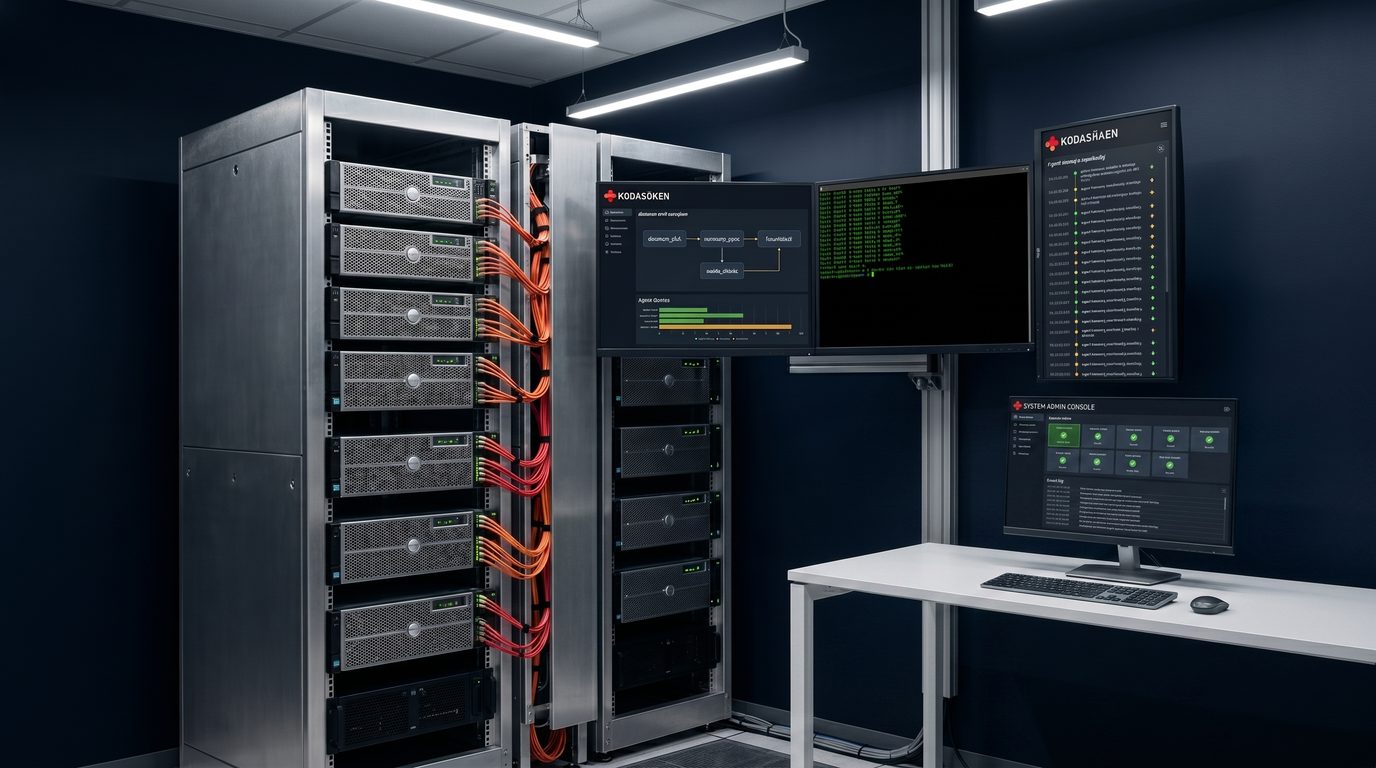
Institutional compute under continuous observation — collection, audit logging and system health that keep running when cognitive services do not.

01 — THE SECURITY PRINCIPLE

A defence that depends on an API is a defence with an outage.

Most AI security tooling assumes the model is reachable. When it is not — an outage, a rate limit, an expired credential, a severed link — the intelligent layer stops and the organisation discovers how much of its security posture was rented rather than owned. Attackers do not schedule around vendor availability.

The question is not how clever the system is at its best. It is what remains when the clever part is gone.

02 — KAGE GUARDIAN

Four functions that never sleep.

KAGE Guardian is the security posture of the KoLo runtime: a set of always-on functions that observe and enforce on local capability, escalating to heavier cognition only when a judgement genuinely requires it.

01 · Persistent monitoringContinuous observation of systems, identities, events and operating state — without requiring permanent frontier inference to stay awake.
02 · Contextual correlationIncidents, anomalies and relationships read against history, dependency and institutional evidence rather than in isolation.
03 · Governed responsePermissions, escalation paths and policy boundaries keep consequential action controlled, attributable and auditable.
04 · RecoveryContainment and restoration that preserve state and evidence, with human oversight held throughout.

03 — FROM EVENTS TO INTELLIGENCE

See the system, not the alert.

Teams drown in disconnected alerts. Context held across time is what turns a signal into a judgement — and the expensive stage runs last, on what survived the cheap ones.

ObserveEvents · identities · assets · behaviourContinuous, and cheap enough to never stop.
CorrelateContext · history · dependencies · evidenceA signal means little until it is placed.
InterpretRisk · intent · impact · priorityWhere cognition earns its cost.
EscalatePolicy · authority · human decisionThe point at which a person is required.
RecoverContain · restore · learn · continueOperations resume; the record persists.

04 — THE SECURITY CONTINUITY THREAD

What the runtime remembers between incidents.

An analyst who leaves takes context with them. A session that ends takes context with it. The thread below is held by the runtime rather than by a person or a conversation, so the second incident is not investigated from zero.

Asset and identity stateWhat exists, who owns it, what it may reach, and how that has changed over time.
Behavioural baselineWhat normal looks like for this system, this account, this hour — established over time rather than assumed.
Incident historyPrior events, their disposition, what was concluded and by whom.
Dependency graphWhat a compromised component actually touches, and what fails with it.
Evidence chainThe observations, timestamps and sources supporting a finding, preserved for review.
Authority recordWho approved which action, under which policy, at what time.
Open questionsUnresolved anomalies and the reason they remain open — carried forward rather than aged out.

05 — SIGNAL CLASSES

What is watched, and why it matters.

Identity anomalyAuthentication patterns, privilege changes, dormant account activation, impossible movement.
Lateral behaviourAccess sequences and reachability that depart from an established baseline.
Data movementVolume, destination, timing and sensitivity of transfers against normal operating shape.
Configuration driftSilent divergence from an approved baseline, including permission and exposure changes.
Operational healthAgent liveness, log continuity, collection gaps — the monitoring of the monitoring.

The last class matters more than it looks. A monitoring system that silently stops collecting reports the same thing as a quiet network — firing is not landing, and absence of alerts is not evidence of safety.

06 — DEGRADED OPERATION

Designed behaviour when things are not fine.

Degradation is a design surface, not an exception path. Each condition below has a defined behaviour, and in every one of them the loss is interpretation quality — never observation itself.

Frontier model unavailableMonitoring, logging, policy enforcement and alerting continue on local capability. Interpretation quality degrades; observation does not stop.
Rate limited or throttledCognitive calls queue behind priority. Routine correlation defers; escalation paths stay open.
Network partitionEdge collection continues locally and reconciles on reconnection, with gaps marked rather than silently closed.
Credential or token expiryThe runtime reports the expiry as an operational fault rather than failing quietly mid-incident.
Vendor outageModel routing moves to an institutional or local model. The security function is not tied to one provider.

07 — AUTHORITY AND ESCALATION

Nothing consequential acts on its own recommendation.

Security is where autonomy is most tempting and most dangerous. Revoking access during a false positive is itself an outage. Authority is therefore tiered by reversibility, not by confidence score.

Authority rises with the cost of being wrong.
Action classWho may perform itConstraint
Observe and recordAutonomicRuns continuously without approval. Cannot change state.
Correlate and rankAutonomicProduces findings and priority. Recommends; does not act.
Reversible actionPolicy-bound agentBounded, logged, reversible, within an explicitly defined envelope.
Consequential actionHuman operatorIsolation, revocation, shutdown. Requires a person with the role.
Irreversible actionAccountable authorityDestruction, disclosure, external notification. Final authority is human.

08 — RECOVERY AND CONTINUITY

Restoration is part of the security function.

Detection without recovery leaves the organisation informed and still down. Recovery is treated as a first-class capability with its own evidence requirements.

Preserve before repairEvidence is captured before remediation destroys the state that explains the incident.
Staged restorationRestore in dependency order, verifying integrity at each stage rather than in one step.
Reintroduce under watchRecovered systems return with heightened observation until baseline behaviour resumes.
Record the failureWhat failed, what was missed, and what would have caught it earlier — written down, not absorbed.

09 — DEPLOYMENT MODELS

Where the security function runs.

EdgeCollection and reflex response local to the site, functioning through connectivity loss.
InstitutionalPrivate infrastructure under the organisation’s own control and jurisdiction.
HybridLocal continuity with escalation to institutional or frontier capability when policy permits.
SovereignNationally controlled compute where regulation or classification requires it.

Sovereignty here means the same thing it means everywhere else on this site — seven layers, not one server →

10 — STATUS AND CLAIM BOUNDARY

What this page does not claim.

The same discipline applied to our research applies to our capability pages. The architecture described above is real work. The following are not established, and saying so here is cheaper than being caught assuming it.

No deployment claimKAGE Guardian is architecture and implementation work, not a product with an installed base we are reporting.
No certification claimNothing here asserts ISO 27001, SOC 2, ISMAP or any other certification of this capability.
No detection benchmarkWe publish no detection or false-positive rate for this capability, because none has been independently measured.
No replacement claimThis is designed to sit with existing security tooling and teams, not to replace a SOC, an EDR or an analyst.

The objective is not to automate every security decision. It is to ensure the organisation can still observe, understand and respond when conditions change — including when the conditions that changed are our own.